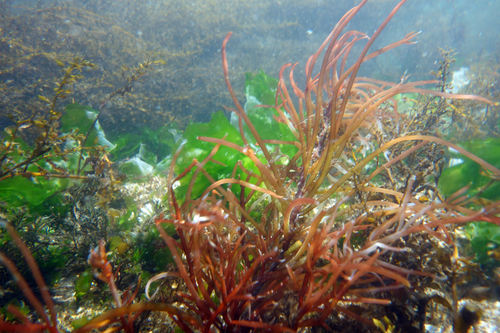
succulent seaweed
Sarcodiotheca gaudichaudii
A vibrant splash of crimson in the Pacific tide pools, succulent seaweed is a master of the intertidal dance. Its fleshy, translucent branches provide a lush underwater forest for the coast's smallest treasures.
Quick Identification
Size
10-40 cm (4-16 inches) in length, with branches typically 2-5 mm (0.1-0.2 inches) in diameter.
Colors
Translucent rose-red to deep crimson; can appear yellowish-green or bleached in high-sunlight shallow pools.
Key Features
- Fleshy, cylindrical branches that taper at both ends
- Irregular or saltatory branching patterns
- Smooth, succulent texture without a central midrib or vein
- Attached to substrate by a small, disk-like holdfast
When You’ll See Them
Behavior
Succulent seaweed is a non-mobile, multicellular red alga that spends its life anchored to rocky substrates or shells. Unlike land plants, it doesn't have a root system; instead, it uses a holdfast to grip rocks, allowing it to withstand the constant tugging of Pacific tides. Its 'behavior' is defined by its growth—it is a fast-growing species that can quickly colonize available space in sheltered rocky reefs and tide pools.
Ecologically, this seaweed acts as a vital 'nursery' habitat. It provides cover and food for a variety of micro-invertebrates, such as isopods and small amphipods, which in turn attract larger backyard coastal visitors like shorebirds and crabs. While it doesn't 'socialize,' it often grows in dense, tufted clumps that create a miniature forest for underwater creatures. To humans, it is a sign of a healthy, nutrient-rich intertidal ecosystem.
EverydayEarth exclusive
Camera Tips
Capturing succulent seaweed requires a different approach than filming mobile wildlife. Because this species is intertidal, the best 'camera trap' is actually a waterproof action camera or a trail camera with a high IP68 waterproof rating. Place your camera during low tide in a stable tide pool. Use a weighted tripod or a 'gorillapod' wrapped tightly around a heavy rock to ensure the camera doesn't wash away when the tide returns. Aim the lens horizontally to capture the seaweed's movement against the water, or top-down for a crisp identification shot.
Timing is everything for the best footage. The most dramatic shots occur as the tide begins to flow back into a pool. This 'refilling' period creates beautiful cinematic movement as the succulent branches begin to sway and unfurl. Set your camera to a time-lapse mode (one frame every 2-5 seconds) to condense an hour of tidal movement into a few seconds of flowing, dance-like motion. If your camera allows, use a macro lens or setting; the translucent, jelly-like texture of Sarcodiotheca gaudichaudii is stunning when captured in high detail.
Lighting in the intertidal zone can be tricky due to reflections on the water's surface. To get the best results, film during the 'golden hours' of early morning or late afternoon when the sun is at an angle, reducing harsh glare. If you are filming underwater in a deep pool, an external waterproof LED light can help pop the vibrant red pigments that define this species. Be sure to clean your lens frequently, as saltwater spray and sand can quickly blur your shots.
Frequently Asked Questions
Record succulent seaweed at your habitat
Connect a camera to start building your own species record — AI identifies every visitor automatically.