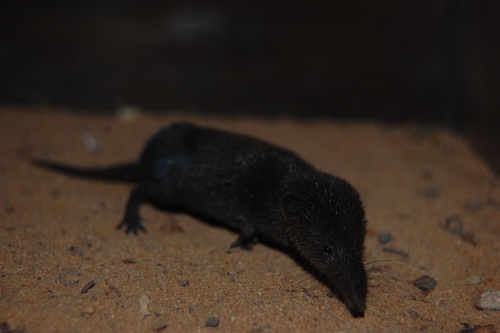
Swamp Musk Shrew
Crocidura mariquensis
A cryptic resident of Africa's wetlands, the Swamp Musk Shrew is a tiny, dark-furred powerhouse that thrives in the thickest reeds. Though rarely seen, this elusive insectivore is a vital part of the swamp ecosystem, patrolling the water's edge day and night.
Quick Identification
Size
Head-and-body: 6.5–10 cm (2.5–4 in); Tail: 4.5–6.5 cm (1.8–2.5 in); Weight: 6–13 g (0.2–0.5 oz)
Colors
Uniformly dark blackish-brown to velvety dark-brown on the back, slightly paler grey-brown on the belly; tail and feet are dark.
Key Features
- Dark, velvety fur without a dorsal stripe
- Long, pointed snout with prominent whiskers
- Short tail roughly 60% of body length
- Small, rounded ears and tiny black eyes
When You’ll See Them
Geographic range
Where Does the Swamp Musk Shrew Live?
Native to the African continent, the Swamp Musk Shrew is primarily found throughout the central and southern regions. Its core population spans across a wide belt including northern South Africa, Botswana’s Okavango Delta, and the lush wetlands of Zambia, Zimbabwe, and Angola. While it is a specialist of damp environments, its range extends into the Democratic Republic of the Congo, Mozambique, and Eswatini, making it a widespread though hidden resident of Africa's major river systems.
Basemap © OpenStreetMap contributors
Behavior
The Swamp Musk Shrew is a secretive and highly active insectivore that spends much of its life hidden within the dense vegetation of wetlands. Unlike some of its relatives, this species is semi-aquatic in its habits, frequently moving through muddy terrain and shallow water in search of prey. It is known for its high metabolic rate, requiring it to forage frequently throughout both day and night to maintain its energy levels.
Socially, these shrews are generally solitary and can be territorial, using specialized scent glands to mark their pathways through the reeds. While they are not typically found in close proximity to humans, they can be discovered in suburban gardens that border natural vlei or marshland. They are generally non-aggressive toward humans but are fierce predators of invertebrates, often tackling prey nearly their own size.
EverydayEarth exclusive
Camera Tips
Capturing a Swamp Musk Shrew on camera requires a specialized approach because of their minute size and preference for dense cover. Place your camera at ground level, no more than 2 to 4 inches off the floor, ideally aimed at a natural clearing or 'runway' within thick reeds or tall grass near a water source. Since these shrews are very small, use a camera with a short minimum focus distance or a dedicated macro lens to avoid blurry images.
To increase your chances of a sighting, use a food lure like dried mealworms or a small amount of wet cat food placed in a shallow dish. Position the bait approximately 3 to 5 feet from the lens to ensure the animal stays within the focal plane. Because shrews are incredibly fast, set your camera to 'Burst Mode' or a high-frame-rate video setting (at least 60fps) to catch their rapid movements before they dart back into the shadows.
Lighting is crucial since this species is most active during the twilight hours and throughout the night. Use a camera with a 'no-glow' or 'low-glow' infrared flash to prevent startling the animal, which can be sensitive to sudden light changes. For the best results, focus your efforts during the drier months when shrews are forced to congregate around permanent water holes, making their movements more predictable.
Frequently Asked Questions
Record Swamp Musk Shrew at your habitat
Connect a camera to start building your own species record — AI identifies every visitor automatically.