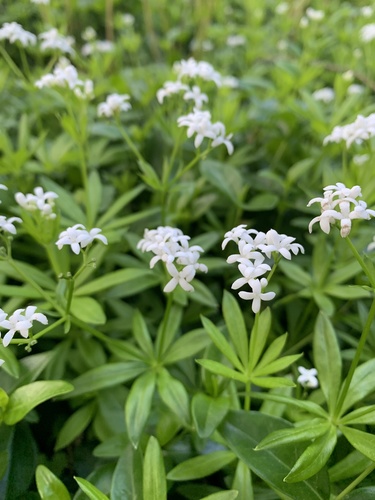
Sweet Woodruff
Galium odoratum
A lush, star-studded carpet for your shade garden, Sweet Woodruff offers a fragrant retreat for both people and pollinators. This elegant woodland native transforms dark backyard corners into a vibrant, vanilla-scented ecosystem every spring.
Quick Identification
Size
6–12 inches (15–30 cm) in height; spreads 12–18 inches (30–45 cm) wide per clump
Colors
Bright emerald green foliage; brilliant white star-shaped blossoms
Key Features
- Whorls of 6-8 lance-shaped leaves per node
- Clusters of small, 4-petaled white flowers
- Mat-forming creeping growth habit
- Sweet scent of vanilla or fresh hay when foliage is dried
When You’ll See Them
Behavior
Sweet Woodruff is a graceful, mat-forming perennial that serves as a living carpet in the shaded parts of the garden. It spreads primarily through creeping underground rhizomes, allowing it to colonize woodland floors and shaded suburban corners without being as aggressive as invasive ivy. It is a 'social' plant in the landscape, often intermingling peacefully with other shade-lovers like Hostas or Ferns.
While the plant appears delicate, it is quite resilient. It goes into a semi-dormant state during extreme summer heat but returns to a vibrant green as temperatures cool. Its most notable 'behavior' is its chemical output; the plant contains coumarin, which produces a powerful, sweet fragrance when the leaves are wilted or dried. Historically, this made it a favorite for 'strewing' on floors to freshen indoor air.
EverydayEarth exclusive
Camera Tips
To capture the true essence of Sweet Woodruff on a backyard camera, you need to think low and wide. Standard fence-height mounts will miss the intricate details of this ground-hugging species. Use a ground-level stake or a 'mini-tripod' to position your camera just 6 to 10 inches above the foliage. Angle the lens slightly downward to show the geometric 'whorl' pattern of the leaves, which provides a stunning visual texture even when the plant isn't flowering.
Since Sweet Woodruff thrives in the shade, light management is your biggest challenge. Look for 'dappled light' periods—usually mid-morning—when sunbeams filter through the trees above. This creates high-contrast, 'sparkling' shots of the white flowers. If your camera has a macro mode or a close-focus setting, this is the time to use it. The four-petaled flowers are tiny, and capturing them in sharp focus against the green leaves creates a professional-grade botanical portrait.
Don't just set your camera for motion triggers; use a time-lapse setting during the peak of spring. Set the interval to one photo every 4-6 hours. Over a week in early May, you will capture the 'white wave' effect as the blossoms emerge and blanket the green foliage. Additionally, because these flowers are rich in nectar for early-season insects, a high-sensitivity motion setting can help you capture the hoverflies and small bees that visit the flowers, adding a dynamic wildlife element to your plant profile.
Finally, consider the post-rain shot. Sweet Woodruff's leaves have a slightly rough texture that catches water droplets beautifully. If you have an AI-powered camera that can be triggered remotely, check your feed immediately after a spring shower. The combination of the deep green leaves, white stars, and crystal-clear water beads is arguably the most aesthetic way to document this species.
Frequently Asked Questions
Record Sweet Woodruff at your habitat
Connect a camera to start building your own species record — AI identifies every visitor automatically.