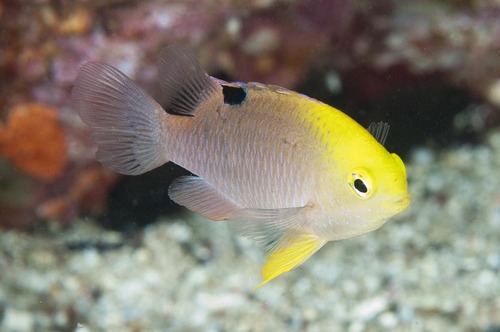
Talbot's Demoiselle
Chrysiptera talboti
With its striking yellow face and deep purple body, Talbot's Demoiselle is a miniature jewel of the Indo-Pacific reefs. This hardy damselfish adds a flash of color and constant motion to any coral garden it calls home.
Quick Identification
Size
A diminutive and sleek species reaching a maximum length of 6 cm (2.4 inches).
Colors
Bright canary-yellow head and chest, contrasting sharply with a deep purplish-gray to charcoal body; features a distinct black spot on the rear of the dorsal fin.
Key Features
- Vibrant yellow head and forebody
- Deep purple to black posterior body
- Prominent black ocellus (spot) on the back of the dorsal fin
- Small, oval-shaped body reaching ~2.4 inches
When You’ll See Them
Geographic range
Where Does the Talbot's Demoiselle Live?
The Talbot's Demoiselle is a tropical treasure primarily found in the vibrant waters of the Indo-West Pacific. Its native range spans from the eastern edges of the Indian Ocean, including the Andaman Sea, through the hyper-diverse coral reefs of Indonesia, Malaysia, and the Philippines. This species also makes a strong showing in the northern Great Barrier Reef of Australia and extends eastward toward the island nation of Palau. Unlike migratory species, these fish are year-round residents of stable, coral-rich environments where they can find ample cover and food.
Basemap © OpenStreetMap contributors
Behavior
Talbot's Demoiselle is a high-energy reef fish that brings a constant sense of motion to the underwater landscape. They are diurnal creatures, meaning they are most active when the sun is high, spending their time patrolling a small territory centered around a favorite coral head. While they are members of the damselfish family—notorious for their pugnacious attitudes—the Talbot's is relatively mild-mannered, often coexisting in loose aggregations rather than engaging in the fierce combat seen in other demoiselles.
Their daily routine revolves around foraging and defense. They are rarely seen far from cover; at the first sign of a predator or a sudden shadow, they will dive headfirst into the intricate branches of Acropora corals. This reliance on coral structures makes them excellent subjects for fixed cameras, as they tend to return to the exact same spot dozens of times throughout the day.
EverydayEarth exclusive
Camera Tips
To successfully capture Talbot’s Demoiselle on an underwater camera, placement is everything. These fish are strictly reef-associated, so you should position your camera housing near branching coral structures, specifically Acropora or Pocillopora species. Aim the lens at a 'cleaning station' or a particular coral head where you see the fish hovering. Keeping the camera at a slightly upward angle toward the surface can help silhouette their unique profile against the ambient light, though a side-on view is best for capturing the sharp contrast between their yellow face and purple body.
Since these fish are small and move with quick, erratic 'hops' through the water, you will need a camera capable of high-speed capture or a very fast shutter speed. If your AI-powered camera allows for custom trigger zones, set the focus area on the edges of the coral branches. Use natural light whenever possible; if you are using artificial lighting, ensure it has a high Color Rendering Index (CRI) to prevent the deep purple of their body from looking like a flat black in the footage.
One of the best 'baits' for Talbot's Demoiselle isn't traditional food, but rather the presence of a healthy reef environment. However, if you are in a controlled setting like a private reef area or large aquarium, small amounts of specialized reef plankton or mysis shrimp can encourage them to linger in front of the lens. Be mindful of tide and surge; stabilize your camera rig with weights or a heavy tripod to prevent the motion of the water from blurring your shots.
Seasonal clarity is also a factor. In many parts of their range, the monsoon season can stir up sediment, making AI recognition difficult. Plan your best recording sessions for the dry season when underwater visibility is at its peak. Regularly cleaning the lens port is essential, as bio-growth and algae can accumulate quickly in tropical waters, obscuring the fine details of the fish's black dorsal spot which is a key identifying feature for AI classification.
Frequently Asked Questions
Record Talbot's Demoiselle at your habitat
Connect a camera to start building your own species record — AI identifies every visitor automatically.