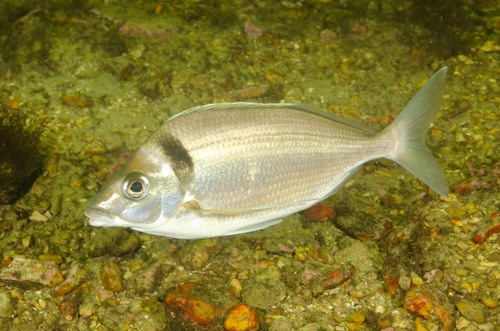
Tarakihi
Nemadactylus macropterus
The Tarakihi is a silver icon of the South Pacific, easily recognized by the striking black 'saddle' across its shoulders. A social reef-dweller, it brings a flash of metallic beauty to our coastal waters.
Quick Identification
Size
Typically 30–60 cm (12–24 inches) in length and weighing 1–3 kg (2.2–6.6 lbs).
Colors
Bright shimmering silver body with a distinctive broad black 'saddle' or band across the shoulder area. Fins often have a slight blue or grey tint.
Key Features
- Prominent black saddle-like band behind the head
- Single elongated pectoral fin ray
- Deeply compressed, silver-blue body
- Small mouth with thick, fleshy lips
When You’ll See Them
Behavior
Tarakihi are highly social, schooling fish that are most commonly found patrolling the edges of rocky reefs and open sandy seafloors. They are known for their inquisitive but cautious nature, often hovering just above the substrate to inspect potential food sources or changes in their environment. In the wild, they form large, shimmering schools that move with a synchronized grace, making them a spectacular sight for underwater observers.
These fish exhibit a predictable daily routine, often moving from deeper waters into shallower reef zones during the day to feed before retreating as light levels change. While they are not aggressive toward humans, they are sensitive to sudden movements and loud vibrations. In coastal communities, they are celebrated not just as a staple seafood but as an indicator species for the health of the local marine ecosystem.
EverydayEarth exclusive
Camera Tips
Capturing the Tarakihi requires a specialized underwater approach, specifically using a Baited Remote Underwater Video (BRUV) setup. To get the best footage, mount your camera to a weighted frame and position it on a flat sandy patch immediately adjacent to a rocky reef edge. This 'ecotone' is where Tarakihi are most active. Angle the lens slightly upward (about 10–15 degrees) to capture the silver scales catching the sunlight filtering down from the surface, which helps the AI distinguish the fish from the darker seafloor.
To bring Tarakihi into the frame, use a perforated bait canister filled with a 'burley' mix of oily fish (like mackerel or sardines) and crushed shellfish. The scent trail is essential for drawing them out from the reef. For the most natural behavior, ensure the camera is set to record in at least 60 frames per second; Tarakihi have a unique way of 'braking' with their long pectoral fin rays, and high-speed footage allows you to see this fascinating mechanic in detail. Set your AI trigger to look for the high-contrast black saddle marking, as this is their most consistent identifying feature.
Visibility is the biggest challenge for underwater 'backyard' cameras. The best time to deploy your equipment is during a high tide on a day with low swell, which minimizes suspended sediment in the water. If you are filming in deeper or murkier water, a wide-angle lens is preferable to keep the subject close to the sensor. Avoid using harsh artificial lights during the day, as the reflection off their silver scales can cause 'white-out' on the footage; instead, rely on natural light between 10 AM and 2 PM when the sun is directly overhead.
Frequently Asked Questions
Record Tarakihi at your habitat
Connect a camera to start building your own species record — AI identifies every visitor automatically.