tarata
Pittosporum eugenioides
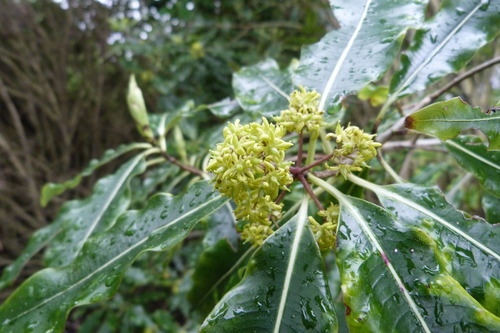
The largest of New Zealand's Pittosporums, the Tarata is a sensory delight known for its shimmering wavy leaves and intoxicating lemon-honey scent. It is a vital 'nursery' tree that brings life and fragrance to any backyard.
Quick Identification
Size
Grows up to 12m (39ft) tall and 5m (16ft) wide; trunk diameter up to 60cm (24in)
Colors
Mottled yellow-green leaves with a bright white midrib; yellow-cream flowers; black seed capsules
Key Features
- Distinctive wavy or undulating leaf margins
- Intense lemon-like fragrance when leaves are crushed
- Large terminal clusters of honey-scented cream flowers
- Bright white, prominent central leaf vein (midrib)
When You’ll See Them
Geographic range
Where Does the tarata Live?
Tarata is an endemic treasure found throughout New Zealand, naturally occurring on both the North and South Islands. It thrives in a variety of environments from sea level up to montane forest edges at approximately 600 meters. While it is native only to New Zealand, its beauty and hardiness have led to it being cultivated in temperate gardens across the United Kingdom, coastal North America, and Australia.
Basemap © OpenStreetMap contributors
Behavior
Tarata, popularly known as Lemonwood, is a vigorous and hardy evergreen tree that acts as a vital pioneer species in New Zealand's ecosystems. It is often among the first trees to colonize forest margins and cleared land, providing a fast-growing canopy that shelters slower-growing, shade-loving species. Its dense, bushy growth habit makes it an exceptional provider of cover for nesting birds and a windbreak for smaller garden plants.
While it appears stationary, the Tarata is a hub of biological interaction. In spring, it produces a massive display of highly fragrant flowers that release a heavy, honey-like scent, particularly potent in the early evening. This attracts a wide variety of native insects and birds. The tree's leaves contain specialized oils and saponins which serve as a natural defense against many pests, though it remains a preferred host for several species of native moths and scale insects.
EverydayEarth exclusive
Camera Tips
To capture the wildlife attracted to your Tarata, position your camera 2-3 meters away from a cluster of flowers during the spring months. The yellow-cream blossoms are a high-traffic zone for pollinators. If your camera supports high-definition video, aim for the terminal ends of the branches where the flower clusters are densest; this is where you'll catch native bees and butterflies in action.
For bird enthusiasts, mount the camera higher up in the mid-canopy or near a sturdy branch that provides a clear view of the seed capsules. Native birds like the Tui and Bellbird (Korimako) are frequently drawn to the tree for nectar and to feed on insects living within the foliage. Because Tarata leaves are glossy and highly reflective, try to angle your camera slightly downward or north-facing to prevent sun glare from triggering false motion alerts or washing out your images.
Don't stop recording when the sun goes down. The Tarata’s evening fragrance is a beacon for nocturnal life. Set your camera to its most sensitive motion setting at night to capture the various species of moths that visit the flowers. If using a trail camera with an infrared flash, ensure it is placed at least 1.5 meters away from the nearest leaves to avoid 'white-out' caused by the IR light reflecting off the light-colored midribs and wavy leaf edges.
Frequently Asked Questions
Record tarata at your habitat
Connect a camera to start building your own species record — AI identifies every visitor automatically.