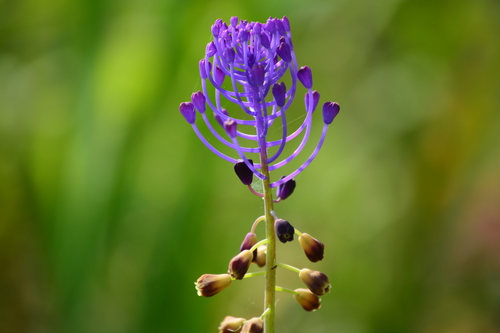
Tassel Hyacinth
Muscari comosum
With its shocking violet tuft and earthy lower bells, the Tassel Hyacinth is one of the most architectural beauties of the Mediterranean spring. A favorite of bees and foragers alike, this hardy bulb brings a touch of wild elegance to any backyard meadow.
Quick Identification
Size
Grows to a height of 20-60 cm (8-24 inches) with flower spikes 5-10 cm (2-4 inches) long
Colors
Bright violet or blue-purple sterile upper flowers; brownish-green or olive-yellow fertile lower flowers; green basal leaves
Key Features
- Distinctive 'tassel' of bright purple sterile flowers at the top
- Urn-shaped, brownish fertile flowers along the lower stem
- Fleshy, strap-shaped leaves that emerge from the base
- Long, leafless flower stalk (scape)
When You’ll See Them
Geographic range
Where Does the Tassel Hyacinth Live?
Native to the Mediterranean region, the Tassel Hyacinth is a common sight across Southern Europe, North Africa, and parts of Western Asia. It flourishes in the sun-drenched soils of countries like Italy, Greece, and Spain, often colonizing rocky hillsides, vineyards, and traditional olive groves. Beyond its native shores, this resilient bulb has naturalized across much of the United Kingdom and various regions of North America, where it has escaped from garden cultivation to brighten local meadows and roadsides.
Basemap © OpenStreetMap contributors
Behavior
The Tassel Hyacinth is a perennial bulbous plant that spends much of the year dormant underground. It emerges in early spring, producing a rosette of long, narrow leaves followed by its highly distinctive flower spike. Unlike many other flowers, the Tassel Hyacinth displays a 'division of labor' among its blooms: the showy purple flowers at the very top are sterile and exist solely to attract pollinators, while the more subdued brownish flowers below handle the actual reproduction.
In its native Mediterranean range, the plant is well-integrated into the local ecosystem and human culture. It attracts various pollinators, primarily bees and bee-flies, which are drawn to the vibrant violet 'tassel.' Humans have a long-standing relationship with this species; in regions like Puglia, Italy, the bulbs (known as lambascioni) are harvested, processed to remove bitterness, and eaten as a traditional delicacy. In the garden or backyard, it is a hardy, low-maintenance plant that often signals the peak of the spring season.
EverydayEarth exclusive
Camera Tips
To capture the Tassel Hyacinth effectively, position your AI-powered camera at a low angle, roughly 6-12 inches from the ground. This 'worm's-eye view' emphasizes the plant's height and makes the distinctive purple tassel stand out sharply against the sky or background greenery. Since plants are stationary, use a tripod or a stable ground mount to ensure crisp focus on the intricate, urn-shaped fertile flowers at the base of the spike.
Time-lapse mode is particularly rewarding with this species. Set your camera to capture an image every 2 to 4 hours during the spring blooming period (typically late March to May). Over a week or two, you will witness the remarkable transformation as the brownish-green lower buds open and the vivid violet tassel elongates. For the best results, choose a location sheltered from heavy winds to minimize motion blur during the sequence and ensure the AI can consistently identify the subject.
If you want to capture the 'wildlife' aspect of this plant, focus your camera's trigger zone on the middle of the flower spike during sunny, mid-morning hours. Tassel Hyacinths are magnets for long-tongued bees and bee flies. Using a fast shutter speed (at least 1/500s) or a high-speed trigger setting will help you capture these pollinators in mid-air as they visit the fertile flowers. Avoid using artificial lighting or heavy flash at night, as it won't help with plant growth and may disrupt the natural activity of the insects you're trying to document.
Similar Species
Species that look similar or are commonly confused with Tassel Hyacinth.
Frequently Asked Questions
Record Tassel Hyacinth at your habitat
Connect a camera to start building your own species record — AI identifies every visitor automatically.