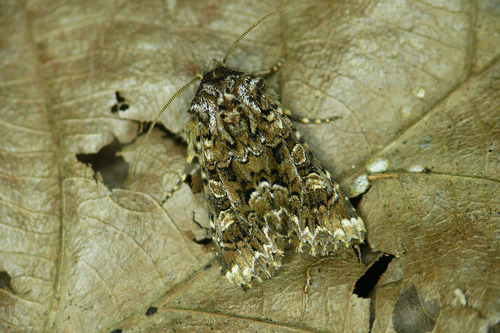
Tawny Shears
Hadena perplexa
A master of camouflage and a specialist of the night, the Tawny Shears is a frequent visitor to moonlit gardens. Known as the 'pod lover,' its life is intricately tied to the wild campions that dot the countryside.
Quick Identification
Size
Wingspan of 27–36 mm (1.1–1.4 inches)
Colors
Mottled tawny, ochre, and grey-brown; forewings feature pale-edged stigmata and a distinctive shear-shaped marking.
Key Features
- Pale shear-like markings on the forewings
- Subterminal white line with dark wedge-shaped spots
- Mottled brown and cream camouflage
- Resting posture with wings tented over the body
When You’ll See Them
Geographic range
Where Does the Tawny Shears Live?
The Tawny Shears is native to the Palearctic realm, with a broad distribution covering most of Europe, North Africa, and temperate Asia including Japan. Within Europe, it is a common sight from the British Isles and Scandinavia down to the Mediterranean basin. While it has not been introduced to North America, it is highly successful across its native range, thriving wherever its specific host plants—various species of campion—are able to grow.
Basemap © OpenStreetMap contributors
Behavior
The Tawny Shears is a primarily nocturnal moth, though it is occasionally disturbed from its resting places during the day. It spends the daylight hours perfectly camouflaged against tree bark, fence posts, or rocky surfaces, where its mottled brown patterns make it nearly invisible to predators. Once darkness falls, it takes flight to feed on the nectar of night-scented flowers, particularly those in the campion family.
The common name 'pod lover' refers to the unique reproductive strategy of this species. Females lay their eggs within the flowers of campions and catchflies. Once the larvae hatch, they move directly into the developing seed pods, feeding on the seeds from the inside out. This specialized relationship makes them a fascinating study in host-plant dependency within a backyard ecosystem.
EverydayEarth exclusive
Camera Tips
To successfully capture the Tawny Shears on your AI-powered camera, focus your efforts on its primary food source: the Campion plant (Silene genus). Position your camera on a small tripod or garden stake about 12 to 18 inches from the flower heads. Because these moths are nectar-feeders that hover or land briefly on blooms, a camera with a fast trigger speed is essential to avoid motion blur.
Since the Tawny Shears is strictly nocturnal, you will need a camera with high-quality infrared (IR) capabilities or a gentle external light source. Using a white sheet behind a flowering patch with a soft UV light can act as a 'moth wall,' attracting them into the frame of your camera. This is a common technique for lepidopterists and works exceptionally well for capturing the intricate wing patterns of the Noctuidae family.
For settings, if your camera allows manual control, use a high ISO to compensate for the dark conditions, but be wary of noise. If you are looking to identify the species specifically, try to capture a top-down view of the moth while it is stationary. This will allow the AI to clearly see the 'shears' marking on the forewings. The best time to set your camera is on warm, humid, and still nights during the early summer months when the first brood is at its peak.
Frequently Asked Questions
Record Tawny Shears at your habitat
Connect a camera to start building your own species record — AI identifies every visitor automatically.