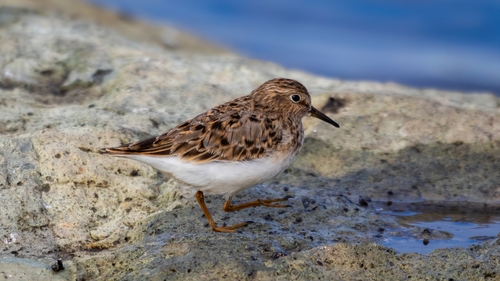
Temminck's Stint
Calidris temminckii
A master of camouflage, the Temminck's Stint is a tiny, mouse-like wader that favors muddy shorelines and freshwater marshes. Discover how to spot this elusive traveler as it journeys between Arctic tundras and tropical wetlands.
Quick Identification
Size
Length: 13.5-15 cm (5.3-5.9 in); Wingspan: 34-37 cm (13-14.5 in); Weight: 15-36 g (0.5-1.3 oz)
Colors
Plain grayish-brown upperparts, white underparts, and distinctive greenish-yellow or dull olive legs. When flying, it shows white outer tail feathers.
Key Features
- Greenish or yellowish legs (never black)
- White outer tail feathers visible in flight
- Crouched, mouse-like walking posture
- Short, straight black bill
- Uniformly drab, unstreaked brownish-gray appearance in winter
When You’ll See Them
Behavior
Temminck's Stints are often described as "mouse-like" because of the way they scurry across muddy banks with a distinctive hunched posture. Unlike many other waders that are highly social and form massive flocks, these birds are frequently seen alone or in very small, loose groups. They have a nervous but systematic foraging style, picking delicately at the mud surface rather than probing deeply like larger shorebirds.
During the breeding season, they exhibit a fascinating "double-clutching" mating system where females may lay two separate clutches of eggs for different males to incubate. When they feel threatened, they tend to crouch low and freeze, relying on their cryptic, earthy plumage to blend into the shoreline. If flushed, they take off with a characteristic towering, zigzagging flight while emitting a trilling call.
EverydayEarth exclusive
Camera Tips
To successfully capture the Temminck's Stint on a trail camera, you must focus on the "micro-habitat" of the shoreline. These birds are incredibly small—roughly the size of a sparrow—so your camera needs to be mounted as low as possible. A ground-level setup, perhaps using a spike mount or a flat rock, just 4 to 6 inches above the mud line is ideal. Position the camera to face a patch of moist mud that is adjacent to some low-growing vegetation, as they prefer these "sheltered" edges over wide-open flats.
Because of their erratic, scurrying movement, motion triggers can sometimes be too slow. If your camera supports it, use a high-frequency time-lapse mode (one photo every 15–30 seconds) during the peak morning hours. If you rely on PIR triggers, set the sensitivity to "High" and ensure the camera is close to the target area—no more than 3 to 5 feet away. Use a fast shutter speed setting to avoid motion blur, as their "mouse-run" behavior is quite rapid.
Natural lighting is your friend here; the golden hours of early morning provide the best contrast to distinguish their greenish legs from the surrounding mud. Look for "micro-signs" to choose your spot, such as tiny needle-point footprints or small pecking holes in the soft silt. Avoid areas with tall reeds that might wave in the wind and cause false triggers, but look for "islands" of mud surrounded by shallow water, which are favorite resting and feeding spots for this species during migration.
Similar Species
Species that look similar or are commonly confused with Temminck's Stint.
Little Stint
Has dark black legs and a more contrasting, 'prettier' plumage with reddish tones in summer, unlike the drabber Temminck's.
Common Sandpiper
Noticeably larger bird that constantly bobs its tail up and down, a behavior the Temminck's Stint lacks.
Least Sandpiper
The North American counterpart; also has yellow legs but usually shows more distinct, darker feather centers on its back.
Frequently Asked Questions
Record Temminck's Stint at your habitat
Connect a camera to start building your own species record — AI identifies every visitor automatically.