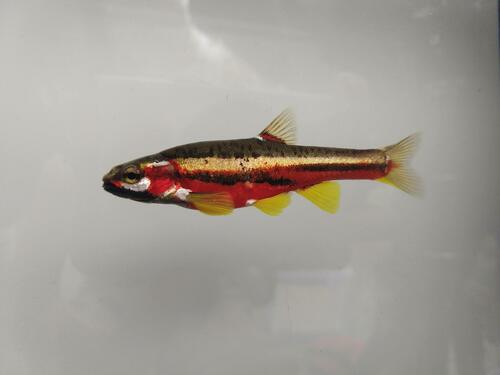
Tennessee Dace
Chrosomus tennesseensis
A hidden gem of Appalachian headwaters, the Tennessee Dace is famous for its vibrant crimson breeding colors and its preference for the tiniest, crystal-clear spring streams.
Quick Identification
Size
5 to 7.5 cm (2 to 3 inches) in length; weighs less than 10 grams (0.35 oz)
Colors
Silvery-gold base with two prominent black lateral stripes; breeding males exhibit brilliant crimson red bellies and yellow-tinted fins
Key Features
- Two distinct dark horizontal stripes along the flanks
- Small, sleek body typically under 3 inches
- Vibrant red underbelly in spawning males
- Small scales giving a smooth appearance
When You’ll See Them
Geographic range
Where Does the Tennessee Dace Live?
Native to the North American continent, the Tennessee Dace occupies a very specific and limited geographic footprint within the southeastern United States. Its core range is restricted to the Ridge and Valley physiographic province, primarily within northeast Tennessee and southwest Virginia, with isolated populations extending into extreme northwest Georgia. This species is a true local specialist, found only in the headwaters of the Tennessee and Holston River systems.
Basemap © OpenStreetMap contributors
Behavior
The Tennessee Dace is a social, schooling fish that spends much of its time navigating the calm pools of small, spring-fed streams. Unlike many larger fish that prefer the center of a river, these dace are specialists of 'first-order' streams—the tiny headwaters that are often no wider than a sidewalk. They are frequently observed hovering near undercut banks or sheltering under submerged roots and woody debris, which provide protection from predators like kingfishers and larger fish.
During the spring spawning season, their behavior becomes particularly fascinating. They are 'nest associates,' meaning they often utilize the gravel nests built by larger minnow species, such as chubs. While the larger fish provides the labor of moving stones and defending the site, the Tennessee Dace moves in to deposit its eggs in the clean gravel. They are non-aggressive toward humans and are primarily observed as quick, flickering flashes of gold and red in clear, shallow water.
EverydayEarth exclusive
Camera Tips
Capturing the Tennessee Dace requires a specialized approach since they live entirely underwater in very shallow environments. For the best results, use a waterproof action camera (like a GoPro) mounted on a small, weighted flat-base or a low-profile tripod. Place the camera inside a quiet pool of a first-order stream, positioning it about 2-4 inches above the stream bed. Aim the lens toward an undercut bank or a patch of submerged woody debris, as these are natural gathering spots for the dace.
Lighting is your biggest challenge in forested stream environments. The best footage is usually captured between 10 AM and 2 PM when the sun is directly overhead, allowing light to penetrate the water surface. Look for 'sun flecks'—bright spots where the canopy opens up—and place your camera in these illuminated patches. If you are filming from above the water, a circular polarizing filter is essential to cut through the surface glare and reveal the fish below.
To encourage the dace to stay in the camera's frame, you can gently disturb the silt just upstream of your camera; the floating organic matter often triggers a feeding response. During the spring (April and May), look for the clear, gravelly nests of chubs. If you place your camera near these nests, you are likely to capture the spectacular sight of male Tennessee Dace in their full red-and-gold spawning colors. Set your camera to a high frame rate (60fps or higher) to capture their quick, darting movements with clarity.
Similar Species
Species that look similar or are commonly confused with Tennessee Dace.
Frequently Asked Questions
Record Tennessee Dace at your habitat
Connect a camera to start building your own species record — AI identifies every visitor automatically.