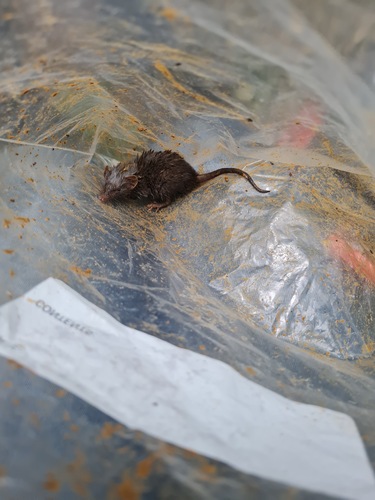
Therese's Shrew
Crocidura theresae
A tiny titan of the West African forest floor, Therese's Shrew is a relentless insect hunter that thrives in the humid shadows of the Ivory Coast and Sierra Leone.
Quick Identification
Size
Total length 11–15 cm (4.3–5.9 inches); weight 10–22 g (0.35–0.78 oz)
Colors
Uniform dark chocolate brown to grayish-slate fur; underparts are subtly paler silver-gray
Key Features
- Elongated, highly mobile snout with sensitive whiskers
- Small, dark eyes and rounded ears visible above fur
- Unpigmented white teeth characteristic of the Crocidura genus
- Tail is roughly 60-70% of head-and-body length
When You’ll See Them
Geographic range
Where Does the Therese's Shrew Live?
This West African mammal is native to the humid tropical zones of the Upper Guinea forest block. Its core population resides in the Ivory Coast and Ghana, extending westward into the lush forests and moist savannas of Guinea, Liberia, and Sierra Leone. It is a lowland specialist, perfectly adapted to the high-humidity environments found near the Atlantic coast of the continent.
Basemap © OpenStreetMap contributors
Behavior
Therese's Shrew is a high-metabolism powerhouse that operates at a frantic pace. Like most white-toothed shrews, it is primarily nocturnal, spending the daylight hours resting in shallow burrows or under dense vegetation. Because of its small size and high surface-area-to-volume ratio, it must eat almost constantly to maintain its body temperature, often consuming its own weight in insects within a 24-hour period.
While largely solitary, these shrews are highly territorial and use scent glands to mark their foraging paths through the leaf litter. They rely heavily on their senses of touch and smell to navigate the complex forest floor, using their long whiskers (vibrissae) to detect the movement of prey in total darkness. Despite their tiny stature, they are fierce predators within their micro-habitat, often tackling insects nearly as large as themselves.
EverydayEarth exclusive
Camera Tips
Capturing Therese's Shrew on camera requires a specialized setup because of their diminutive size and rapid movement. You should place your camera at the lowest possible height, ideally directly on the ground or propped up just 2-3 inches high. Angle the lens slightly downward to focus on a clear patch of leaf litter. Because these shrews move so quickly, a camera with a trigger speed of 0.2 seconds or faster is essential to avoid capturing just a tail or a blurry streak.
The best locations for placement are 'micro-highways'—the natural gaps under fallen logs, the base of large buttress roots, or alongside dense fern clumps. These are the corridors shrews use to stay protected from owls and other predators. If your camera has a 'Macro' or 'Close-up' focus setting, now is the time to use it, as the shrew will likely be passing within 1-3 feet of the lens.
To encourage the shrew to pause for a clear photo, use a scent-based attractant rather than a large pile of food. A small cotton ball soaked in sardine oil or a tiny smear of wet cat food placed inside a perforated PVC pipe will keep them sniffing in one spot for several seconds. This 'hold' is critical for getting a sharp image. Since they are nocturnal, ensure your infrared flash is set to 'High' but consider diffusing it with a piece of semi-transparent tape if the close-up images appear washed out.
Frequently Asked Questions
Record Therese's Shrew at your habitat
Connect a camera to start building your own species record — AI identifies every visitor automatically.