Thick-billed Raven
Corvus crassirostris
Towering over other songbirds, the Thick-billed Raven is a mountain-dwelling giant with an unmistakable ivory-tipped beak. This intelligent scavenger is the undisputed king of the Horn of Africa’s high plateaus.
Quick Identification
Size
Length: 60–70 cm (24–28 in); Weight: 1.15–1.5 kg (2.5–3.3 lb); Wingspan: up to 150 cm (59 in)
Colors
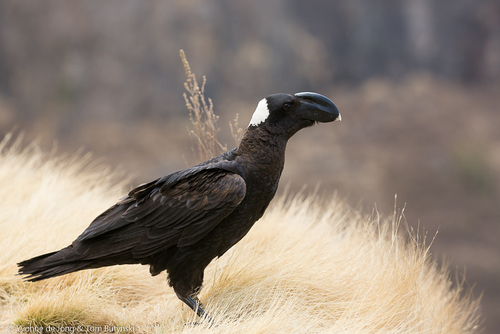
Glossy black plumage with a large, distinct white patch on the nape (back of the neck) and a white-tipped beak.
Key Features
- Massive, deeply arched black bill with a white tip
- Prominent white patch on the back of the neck
- Heaviest passerine (songbird) in the world
- Distinctive deep, guttural croak
When You’ll See Them
Behavior
These birds have adapted remarkably well to human presence, often frequenting mountain villages and agricultural land where they scavenge for scraps. Their vocalizations are famous for being exceptionally deep and harsh—a low 'phruu-phruu' that can be heard from a great distance. Despite their size, they are playful and have been observed performing aerial acrobatics, diving and rolling in the wind for no apparent reason other than enjoyment.
EverydayEarth exclusive
Camera Tips
Capturing the Thick-billed Raven on a trail camera requires targeting their specific foraging habits in high-altitude environments. Because these ravens spend much of their time searching for insects and scraps on the ground, place your camera approximately 2 to 3 feet high, angled slightly downward. Look for flat, rocky outcroppings or areas near livestock enclosures where they are known to scavenge. In a backyard setting within their range, a stone wall or a large flat boulder serves as an ideal 'stage' for your camera to capture their massive profile.
To successfully lure this species, use high-protein baits like meat scraps or suet. Unlike smaller birds, Thick-billed Ravens are intelligent and may be suspicious of a new camera; it is often helpful to leave the camera in place for several days before expecting high-quality 'natural' behavior. Using a camera with a fast trigger speed is essential, as their movements—pecking at the ground or tossing stones—are surprisingly rapid and can lead to motion blur in slower devices.
Lighting is the biggest challenge when photographing jet-black birds. To avoid a 'black silhouette' effect, position your camera so the sun is behind it, particularly during the early morning hours. This front-lighting will help the camera sensor pick up the iridescent sheen of their feathers and the critical detail of the white patch on their nape. If your camera has adjustable exposure settings, bumping the exposure compensation up slightly (+0.3 or +0.7) can help reveal the textures in their dark plumage.
During the dry season, a water source can be an even more effective draw than food. A wide, shallow stone basin filled with fresh water can attract a pair for bathing or drinking. Be sure your camera is securely mounted; these birds are incredibly curious and strong enough to peck at or even move a camera that isn't firmly attached to a post or tree trunk. High-resolution video settings are recommended to capture their unique, deep vocalizations, which are just as impressive as their visual appearance.
Similar Species
Species that look similar or are commonly confused with Thick-billed Raven.
Frequently Asked Questions
Record Thick-billed Raven at your habitat
Connect a camera to start building your own species record — AI identifies every visitor automatically.