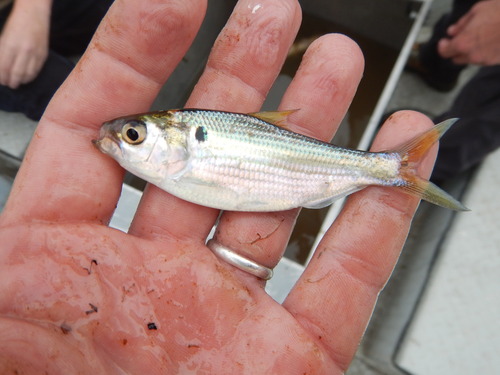
Threadfin Shad
Dorosoma petenense
A shimmering silver resident of America's waterways, the Threadfin Shad is the energetic pulse of the lake. Recognizable by its golden fins and 'thread-like' dorsal fin, this social fish transforms the water's surface into a dancing display of light at dawn and dusk.
Quick Identification
Size
Typically 3-5 inches (7.6-12.7 cm), rarely reaching up to 8 inches (20 cm); weight is usually only a few ounces.
Colors
Silvery-white sides with a blue-grey or greenish back; fins often show a distinct yellowish hue, particularly the tail (caudal fin).
Key Features
- Elongated, thread-like ray at the rear of the dorsal fin
- Terminal mouth where the upper and lower jaws meet evenly
- Yellowish tint on the tail and pectoral fins
- Small dark 'shoulder spot' located just behind the gill cover
When You’ll See Them
Behavior
Unlike many other shad species, Threadfin are extremely sensitive to environmental stressors. They are known for 'die-offs' when water temperatures plummet below 42°F or when dissolved oxygen levels fluctuate rapidly. Because of this sensitivity, they are often used by biologists as an indicator species for the overall health and temperature stability of a lake or river system.
While they are not a 'backyard' animal in the terrestrial sense, they are a staple for anyone with a dock or waterfront property. They are most active during the low-light hours of dawn and dusk, when they can be seen 'dimpling' the water's surface as they feed on microscopic organisms. They generally avoid deep, dark water, preferring the sunlit zones where their food source is most abundant.
EverydayEarth exclusive
Camera Tips
To capture high-quality footage of Threadfin Shad, you will need an underwater camera system or an action camera with a waterproof housing. Because these fish are surface-dwellers, mount your camera relatively shallow—between 1 and 3 feet deep. Positioning the lens to face slightly upward toward the surface will help catch the 'silver flash' of their scales as they catch the sunlight, which is essential for AI-powered motion triggers to recognize them.
The most effective 'lure' for Threadfin Shad is light. If you have a dock, installing a submersible green or white LED light is the gold standard for attracting these fish. At night, the light concentrates plankton, which in turn draws in massive, swirling schools of shad. Setting your camera's focus to a fixed point about 2-4 feet away from the light source will ensure that the fast-moving school stays in sharp relief against the dark water.
For those using trail cameras above the water, look for areas of 'surface activity.' During the summer months, shad often congregate near aerators, fountains, or moving currents where oxygen levels are highest. Aim your camera at the 'ripple line' where moving water meets still water. Because they move so quickly, use a high frame rate (60fps or higher) if your camera allows it; this prevents the shimmering school from appearing as a silver blur.
Seasonal timing is critical for camera placement. In the spring, they move toward shorelines and rocky banks to spawn, making this the best time for shallow-water setups. In the heat of late summer, they may retreat slightly deeper during the day but will consistently return to the surface at dusk. If you notice a sudden drop in activity during winter, it is likely because the school has moved to deeper, warmer pockets of the lake to survive the cold.
Similar Species
Species that look similar or are commonly confused with Threadfin Shad.
Frequently Asked Questions
Record Threadfin Shad at your habitat
Connect a camera to start building your own species record — AI identifies every visitor automatically.