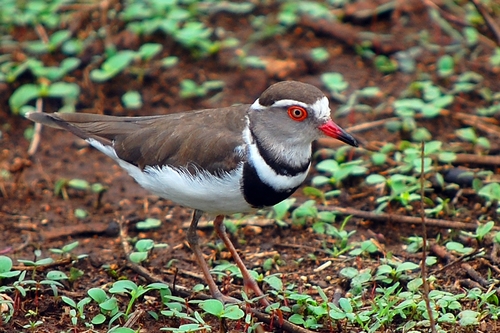
Three-banded Plover
Thinornis tricollaris
Meet the dapper resident of the African shoreline. With its signature double-black breast bands and vivid red eye-rings, the Three-banded Plover brings a touch of elegance to every muddy bank and garden pond.
Quick Identification
Size
Length: 17-18 cm (6.7-7.1 in); Weight: 25-44g (0.9-1.5 oz); Wingspan: 35-40 cm (14-16 in)
Colors
Muted grey-brown upperparts and a white belly. The chest features two distinct black bands separated by a white band. Adults possess a striking bright red orbital ring around the eye and a red-to-pink base on a black-tipped bill.
Key Features
- Two black breast bands separated by a white bar
- Bright red ring around the eye
- Noticeably long tail for a plover
- Pinkish-red legs and bill base
When You’ll See Them
Behavior
The Three-banded Plover is an elegant and largely sedentary wader, often found patrolling the muddy margins of inland water bodies. Unlike many shorebirds that undertake massive migrations, this species generally stays put as long as its water source remains. You will most likely spot them as solitary individuals or in pairs, though they occasionally gather in small, loose flocks during the dry season when water is scarce.
Their movement is a rhythmic dance of sudden sprints followed by abrupt freezes. This 'run-and-stop' technique allows them to spot the subtle movement of prey in the mud. While they are relatively bold and will allow a close approach, they maintain a 'safety zone,' taking flight with a sharp, high-pitched whistle if they feel crowded, showcasing their surprisingly long and pointed wings in flight.
EverydayEarth exclusive
Camera Tips
To capture the Three-banded Plover, camera placement is everything. You must position your camera at 'worm's-eye level'—no more than 4 to 6 inches off the ground. These birds spend their entire lives on their feet, and a high-angle shot will lose the detail of their striking red eye-rings and breast bands. Look for 'landing strips' of flat, moist mud at the edge of a pond or dam where footprints are already visible.
Because these plovers move in quick, erratic bursts, trigger speed is critical. Set your AI camera to its most sensitive motion setting and use 'Burst Mode' or 'Photo + Video' to ensure you catch the action. If your camera allows for it, a high shutter speed is preferred to freeze the motion of their rapid pecking and sprinting behavior. If the area is cluttered, clear away any tall grass or reeds directly in front of the lens to prevent the autofocus from jumping to the foreground vegetation.
Lighting can make or break your shots of this species. Aim your camera with the sun at your back during the 'golden hours' of early morning or late afternoon. This directional light will illuminate the red eye-ring and the contrasting black-and-white bands on the chest. Avoid placing cameras in deep shade, as the bird's brown back provides excellent camouflage that can cause it to blend into the shadows.
If you are trying to attract them to a specific backyard spot, the secret is consistent moisture. They aren't interested in birdseed, but a shallow, sloping birdbath or a dedicated 'mud patch' kept damp with a drip system will act as a magnet. They prefer open areas with clear sightlines to feel safe from predators, so avoid placing your camera and water feature too close to dense shrubbery where cats or raptors might hide.
During the dry months, these birds become much more predictable as they congregate at permanent water holes. This is the best time to set up your gear. Use a wide-angle lens if possible to capture the bird within its shoreline environment, as their elongated profile—caused by their long wings and tail—makes for a very artistic composition against the reflection of the water.
Similar Species
Species that look similar or are commonly confused with Three-banded Plover.
Frequently Asked Questions
Record Three-banded Plover at your habitat
Connect a camera to start building your own species record — AI identifies every visitor automatically.