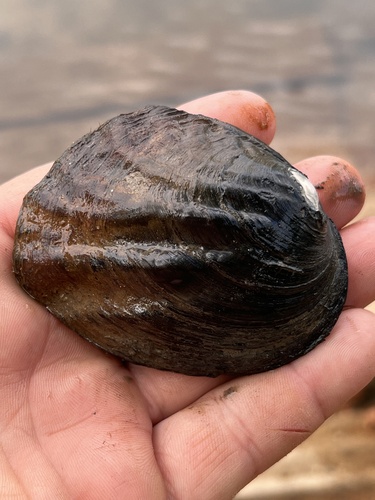
Three-ridge Mussel
Amblema plicata
The Three-ridge Mussel is a silent engineer of our freshwater ecosystems, using its rugged, corrugated shell to withstand powerful river currents. This long-lived bivalve is a master of filtration, tirelessly cleaning the water for all other aquatic life.
Quick Identification
Size
Typically 7.5 to 15 cm (3 to 6 inches) in length, though exceptional specimens can reach 18 cm (7 inches). They are notably heavy and thick-shelled.
Colors
Dark brown, olive, or blackish exterior (periostracum); the interior nacre is a brilliant, iridescent pearly white, sometimes with a purple or pinkish hue near the hinge.
Key Features
- Three to five large, prominent diagonal ridges across the shell
- Extremely thick, heavy, and solid shell structure
- Dark, brownish-black outer skin that erodes to reveal white
- Sub-quadrate or rectangular shell shape
- Iridescent white interior with heavy hinge teeth
When You’ll See Them
Geographic range
Where Does the Three-ridge Mussel Live?
Native to the heart of North America, the Three-ridge Mussel is most abundant throughout the vast Mississippi River drainage system. Its range extends from the Great Lakes and St. Lawrence River basin in the north, down through the central and eastern United States, and as far south as the Gulf Coast and parts of Mexico. These resilient bivalves thrive in the diverse river systems of the Midwest and South, making them one of the most widely distributed freshwater mussels on the continent.
Basemap © OpenStreetMap contributors
Behavior
The Three-ridge Mussel is a sedentary filter feeder that spends most of its life partially buried in the riverbed or lake bottom. While they may appear motionless, they are constantly active, pumping large volumes of water through their siphons to extract oxygen and microscopic food particles. By doing so, they act as natural water purifiers, significantly improving the clarity and quality of their aquatic environment.
These mussels have a fascinating reproductive cycle that involves a temporary parasitic stage. They release larvae, known as glochidia, which must attach to the gills or fins of a host fish—typically sunfish, bass, or catfish—to develop. This relationship allows the mussel to travel upstream or to new habitats that they could never reach on their own. Once the larvae mature into juvenile mussels, they drop off the fish and settle into the substrate to begin their long lives, which can span several decades.
EverydayEarth exclusive
Camera Tips
Capturing a Three-ridge Mussel on a backyard or trail camera requires a specialized approach since they are underwater and move very slowly. The best strategy is to use an action camera with a waterproof housing or a dedicated underwater trail cam. Place the camera on a weighted tripod or secure it to a heavy rock on the riverbed, angling it slightly downward toward a known mussel bed. Clear, shallow water during the summer months provides the best visibility and natural lighting.
Because mussels don't move enough to trigger standard motion sensors, you must use a 'Time Lapse' mode. Setting your camera to take one photo every 5 to 10 minutes over a several-hour period will allow you to see the mussels 'creeping' through the substrate or extending their siphons. If you are positioned in a backyard creek, look for the distinctive 'tracks' or furrows they leave in the sand to find an active individual.
For the best results, focus on the siphons. When the mussel is undisturbed, it will open its shell slightly and extend two fleshy tubes. One draws water in, and the other expels it. Capturing this 'breathing' behavior is the hallmark of a great mussel observation. Avoid using heavy artificial lights at night, as this can attract fish that might bump the camera; instead, rely on the high-contrast patterns of the shell during daylight hours.
Frequently Asked Questions
Record Three-ridge Mussel at your habitat
Connect a camera to start building your own species record — AI identifies every visitor automatically.