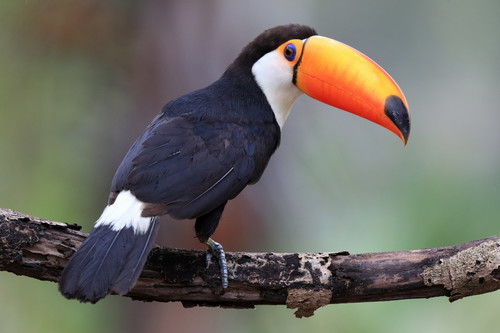
Toco Toucan
Ramphastos toco
Meet the flamboyant icon of the South American tropics. With its oversized orange beak and curious personality, the Toco Toucan is a show-stopping visitor for any backyard observer.
Quick Identification
Size
Length: 55-65 cm (22-26 in); Wingspan: approx. 119-142 cm (47-56 in); Weight: 500-875 g (1.1-1.9 lbs)
Colors
Jet black body with a brilliant white bib (throat and chest); orange-yellow bill with a black base and tip; blue skin around eyes; red undertail feathers.
Key Features
- Massive orange-yellow beak with a black spot at the tip
- Vivid white throat and chest contrasting with black plumage
- Bright blue skin surrounding the eye
- Red undertail-coverts and white uppertail-coverts
When You’ll See Them
Behavior
The Toco Toucan is the gregarious 'gentle giant' of the toucan family. While they can be seen alone, they are more often found in pairs or small family groups of up to six individuals. They have a playful, almost curious nature, and are known to engage in 'bill-fencing' or fruit tossing as part of social bonding or courtship rituals. Unlike many rainforest birds, they aren't shy about human proximity and have adapted well to modified landscapes like plantations and suburban neighborhoods.
One of their most fascinating behaviors involves thermoregulation. That massive beak isn't just for eating; it’s a sophisticated heat radiator. By controlling blood flow to the beak, they can shed body heat in the tropical sun or conserve it during cool nights. When they sleep, they often tuck their bills under their wings and flip their tails forward to become a compact, cozy ball of feathers.
EverydayEarth exclusive
Camera Tips
To capture the perfect shot of a Toco Toucan, height is your best friend. While they do occasionally descend to the ground to pick up fallen fruit or drink water, they spend 90% of their time in the canopy or mid-story. Mount your camera at least 10 to 15 feet high, ideally on a branch overlooking a known fruiting tree like a papaya, guava, or acai palm. If you are using a backyard setup, try to position the camera on a balcony or a tall pole near a high-mounted bird bath, as they are large birds that prefer an easy approach path without dense foliage.
Since the Toco Toucan has high-contrast colors—bright white against deep black—exposure can be tricky. If your AI camera allows for exposure adjustments, try to underexpose slightly during the midday sun to prevent the white throat feathers from 'blowing out' and losing detail. Because they are active during the brightest parts of the day, you won't usually need infrared flash, but having a fast trigger speed is essential. Toucans are 'hoppers'; they rarely sit still for long and tend to bounce between branches with surprising agility.
If you want to lure them into frame, focus on their appetite for fruit. A platform feeder stocked with halved papayas or ripe bananas is almost irresistible. However, be mindful of the angle; because their beaks are so long, they often turn their heads sideways to examine objects. Position your camera to capture a side-profile view to ensure that iconic 8-inch beak fits entirely within the frame. Seasonal timing is also key; in the southern parts of their range, they are much more active and vocal during the breeding season from September to January, which is the best time to capture social interactions.
Similar Species
Species that look similar or are commonly confused with Toco Toucan.
Frequently Asked Questions
Record Toco Toucan at your habitat
Connect a camera to start building your own species record — AI identifies every visitor automatically.