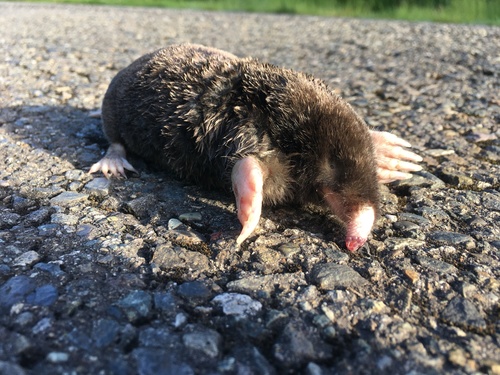
Townsend's Mole
Scapanus townsendii
Meet the subterranean powerhouse of the Pacific Northwest. As the largest mole in North America, the Townsend's Mole is a master excavator that turns your backyard soil into a complex, life-supporting network.
Quick Identification
Size
7.9–9.3 inches (20–23.5 cm) in length; weighs 3.5–5.3 oz (100–150 g)
Colors
Uniformly velvety black to dark slate gray, often with a subtle purplish or bronze sheen; pinkish snout and feet
Key Features
- Broad, shovel-like foreclaws designed for 'swimming' through soil
- Noticeably larger than any other North American mole species
- Tiny, skin-covered eyes and no external ear flaps
- Velvety fur that can be brushed in any direction without resistance
When You’ll See Them
Behavior
Townsend's Moles are the heavyweights of the subterranean world, spending nearly their entire lives within a complex network of tunnels. Unlike many other small mammals, they are fiercely solitary and territorial, patrolling their underground "highways" to harvest earthworms and larvae that fall into the passages. They are remarkably efficient excavators, capable of moving massive amounts of soil relative to their body size, which results in the characteristic volcanic mounds seen in Pacific Northwest landscapes.
While often viewed as a nuisance by homeowners, these moles are vital ecosystem engineers. Their tunneling aerates the soil and improves drainage, while their diet helps regulate populations of garden pests. They do not hibernate and remain active throughout the winter, though they may dig deeper during freezes. They rarely venture above ground, typically only doing so as juveniles searching for new territory or when flooded out by heavy rains.
EverydayEarth exclusive
Camera Tips
Capturing a Townsend's Mole on camera is a rewarding challenge because of their fossorial lifestyle. To see them, you must focus on their surface activity. Look for "fresh" mounds where the soil is still dark and moist. Place your camera on a ground-level mount or a very short stake, aimed directly at the side of a new mound. Because these moles are low-profile, a camera with a short focal distance is essential to avoid blurry shots. If your camera has a macro mode or adjustable focus, use it here.
Timing your deployment with the weather is the secret to success. These moles are most likely to push up new dirt or even surface briefly during or immediately after heavy rain, as the moisture drives their prey upward. In the Pacific Northwest, the peak activity for mound building is typically between November and March. Set your camera to a high-sensitivity PIR (motion sensor) setting and use short video clips (10-15 seconds) rather than stills. This allows you to see the soil moving as the mole works just beneath the surface.
For the best chance of seeing the animal itself, look for "surface runs"—long, raised ridges in the grass where the mole has tunneled just under the sod. If you find a run that has been partially opened by a predator or a garden tool, aim the camera at the opening. While they aren't attracted to traditional baits, ensuring your lawn is healthy and pesticide-free provides the natural earthworm population that keeps them coming back to the same area. If you're lucky, you might catch a juvenile "dispersing" across the surface in late spring, so keep a camera focused on garden edges or fence lines during May and June nights.
Similar Species
Species that look similar or are commonly confused with Townsend's Mole.
Frequently Asked Questions
Record Townsend's Mole at your habitat
Connect a camera to start building your own species record — AI identifies every visitor automatically.