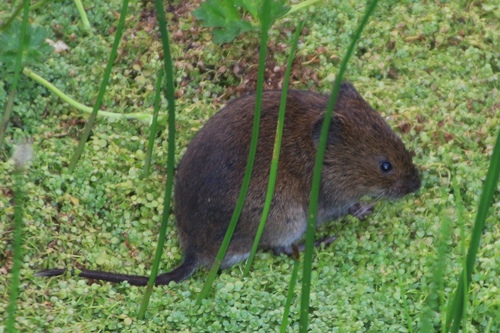
Townsend's Vole
Microtus townsendii
The largest vole in North America, the Townsend's Vole is a master of the hidden meadow. Often heard but rarely seen, this chocolate-colored rodent builds a secret world of tunnels and trails right beneath the grass.
Quick Identification
Size
Total length 170–250 mm (6.7–9.8 in); tail length 48–72 mm (1.9–2.8 in); weight 50–150 g (1.8–5.3 oz)
Colors
Dark brownish-black to chocolate brown upper parts with a grayish-white or buff-colored belly; tail is bicolored, dark above and lighter below
Key Features
- Largest vole species in North America
- Long tail comprising nearly 1/3 of total body length
- Small, rounded ears that barely protrude from the fur
- Stocky, robust body with short legs
When You’ll See Them
Behavior
These rodents are not true hibernators and remain active throughout the year, even tunneling through snow in the winter. They are somewhat social and can live in high-density colonies when food is abundant. While they generally avoid human contact, they thrive in suburban environments that offer 'wild' corners with tall grass or thick mulch, where they can forage in relative safety.
EverydayEarth exclusive
Camera Tips
If you aren't seeing runways, try placing the camera near the edge of a garden bed or along a fence line, as voles prefer to travel along solid edges that provide a sense of security. Baiting can be very effective for keeping them in the frame long enough for a clear ID. A small pile of birdseed, a slice of apple, or even a smudge of peanut butter on a rock will encourage them to pause. Since they are most active during the low-light hours of dawn and dusk, ensure your camera's infrared LEDs are unobstructed and clean for crisp black-and-white night shots.
For the best results, use a 'burst' photo mode or short 10-15 second video clips. These voles are nervous and rarely sit still; a single photo might only capture a blurry tail, but a video will reveal their characteristic 'dash-and-stop' foraging behavior. If your camera allows for it, set the focus range to 'near' to ensure the rodent isn't a blurry blob in the foreground. In the winter, look for 'vent holes' in the snow near tree trunks or bushes—these are perfect spots to point a camera to catch them emerging for a quick snack.
Similar Species
Species that look similar or are commonly confused with Townsend's Vole.
Frequently Asked Questions
Record Townsend's Vole at your habitat
Connect a camera to start building your own species record — AI identifies every visitor automatically.