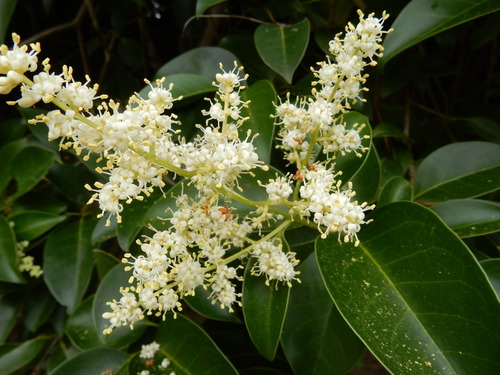
tree privet
Ligustrum lucidum
A resilient evergreen with glossy foliage and fragrant summer blooms, the Tree Privet is a common cornerstone of suburban landscapes. While it provides essential winter forage for birds, its rapid growth makes it a fascinating, if sometimes controversial, subject for backyard observation.
Quick Identification
Size
A medium-sized evergreen tree typically reaching 10–15 meters (33–50 feet) in height, with a canopy spread of 5–10 meters (16–33 feet).
Colors
Glossy, dark green upper leaf surfaces with paler undersides; panicles of tiny, creamy-white flowers; clusters of green berries that ripen to a deep purple-black.
Key Features
- Large, leathery, oval leaves with a distinct glossy finish
- Dense, conical clusters (panicles) of fragrant white flowers
- Clusters of small, oblong purple-black berries
- Smooth, greyish-brown bark that becomes slightly fissured with age
When You’ll See Them
Behavior
Despite its ornamental history, it is widely regarded as a 'behaviorally aggressive' invasive species in many parts of the world. It effectively 'out-competes' local flora by producing thousands of seeds per season and exhibiting high tolerance for both shade and drought. Its interactions with local fauna are primarily centered on seed dispersal; fruit-eating birds are attracted to the nutrient-rich berries during the winter, inadvertently carrying the seeds to new locations.
EverydayEarth exclusive
Camera Tips
Lighting is crucial for getting clear identification shots of the glossy leaves and dark fruit. Whenever possible, position your camera with the sun at its back (facing north in the northern hemisphere) to avoid the high-contrast glare that can occur off the waxy leaf surfaces. Using a 'Burst Mode' or 'Photo + Video' setting is highly recommended, as the birds visiting the tree are often fast-moving and may only stay for a few seconds to grab a berry before flying off.
If you are interested in the insect biodiversity the tree supports, consider setting up a macro-focused camera near the flower panicles during the summer bloom. Because the flowers are highly fragrant and produce abundant nectar, you can capture high-quality footage of diverse pollinators. Adjust your motion sensitivity to 'High' to ensure the camera triggers for smaller insects like butterflies or rare bees. However, be wary of windy days; the broad leaves of the Tree Privet catch the wind easily, which can lead to hundreds of false triggers if your sensitivity is too high and your frame includes too much moving foliage.
For a long-term project, use a time-lapse setting of one photo every day at noon. This will allow you to see the seasonal transformation of the tree, from the emergence of the flower buds to the heavy weight of the winter berries. Ensure your camera is securely fastened with a strap or mount that can withstand the tree's growth over several months without shifting, and check the lens periodically for the sticky residue that the flowers can sometimes drop.
Frequently Asked Questions
Record tree privet at your habitat
Connect a camera to start building your own species record — AI identifies every visitor automatically.