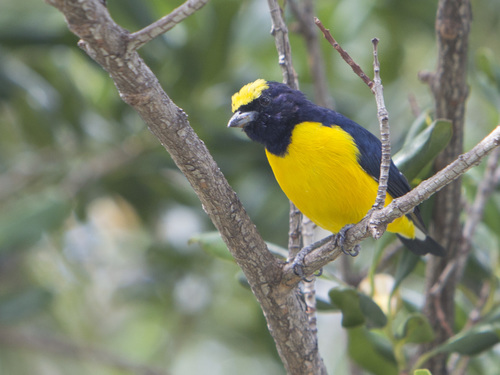
Trinidad Euphonia
Euphonia trinitatis
The Trinidad Euphonia is a pint-sized powerhouse of color and song, famous for its love of mistletoe and its ability to mimic neighbors. These stocky little 'jewels' bring a vibrant energy to garden canopies across the tropics.
Quick Identification
Size
Length: 3.5 to 4 inches (9-10 cm); Weight: 0.3 to 0.4 oz (8.5-11 g)
Colors
Males feature glossy blue-black upperparts and throat with a vibrant yellow crown and belly. Females are olive-green above with a grayish belly patch.
Key Features
- Small, stocky build with a noticeably short tail
- Male has a bright yellow forehead and crown paired with a dark blue-black throat
- Female has a distinctive gray vertical patch on her breast and abdomen
- High-pitched, two-note whistling calls
When You’ll See Them
Behavior
The Trinidad Euphonia is a charismatic and social songbird, usually spotted in pairs or small family groups. They are highly active foragers, moving with a restless energy through the treetops. One of their most fascinating behaviors is their vocal mimicry; they are known to incorporate the calls of other bird species into their own songs, creating a complex and sometimes confusing auditory landscape for the casual observer.
While they are primarily canopy dwellers, they are frequent visitors to gardens and edges of human settlements, provided there is a good supply of fruit and water. They are less shy than many other forest birds and will often remain in a single fruiting tree for a significant amount of time, making them excellent subjects for backyard observation if you have the right attractants.
EverydayEarth exclusive
Camera Tips
Capturing the Trinidad Euphonia requires focusing on their specific vertical niche. These birds prefer to stay at least 5 to 15 feet off the ground. For the best results, mount your camera near an elevated water feature or a platform feeder. A dripping water sound is a magnetic lure for them; a solar-powered fountain or a simple 'dripper' over a bird bath will significantly increase your chances of a close-up.
Place your camera near fruit-bearing plants, specifically mistletoe or tropical shrubs like Melastomes. If you are using supplemental feed, offer soft fruits like overripe bananas, papaya, or halved oranges. Position the camera about 3-4 feet from the feeder to account for their small size. Because they are fast-moving and tend to flit rather than perch for long periods, set your AI camera to its highest sensitivity and use 'Burst Mode' to capture multiple frames of their rapid movements.
Lighting is crucial for these birds. The male's blue-black plumage can look like a flat black silhouette in poor light; try to position your camera so the morning sun hits the feeder or bath directly. This will reveal the iridescent 'glossy' blue sheen of the male and the subtle olive gradients of the female. Avoid placing cameras in deep, permanent shade where the bird's quick movements will result in motion blur.
Similar Species
Species that look similar or are commonly confused with Trinidad Euphonia.
Violaceous Euphonia
The male Violaceous Euphonia has an entirely yellow underside including the throat, whereas the Trinidad Euphonia has a dark throat.
Thick-billed Euphonia
The Thick-billed Euphonia is slightly larger with a noticeably heavier beak and the male's yellow crown extends further back toward the nape.
Frequently Asked Questions
Record Trinidad Euphonia at your habitat
Connect a camera to start building your own species record — AI identifies every visitor automatically.