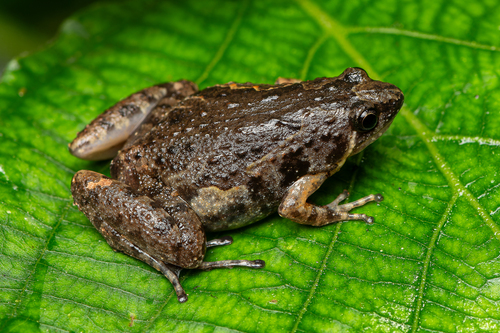
Tubercled Pygmy Frog
Microhyla butleri
The Tubercled Pygmy Frog is a pocket-sized wonder of the Asian undergrowth. Known for its 'painted' markings and a voice that punches far above its weight, this adaptable amphibian is a common guest in suburban gardens.
Quick Identification
Size
A very small frog, typically reaching 20–25 mm (0.8–1.0 inches) in length.
Colors
Usually grey or light brown with a dark, symmetrical 'arrow' or 'X' pattern on the back. Often features reddish-orange tubercles (bumps) and faint pink or orange flashes on the hidden parts of the legs.
Key Features
- Distinctive dark 'arrowhead' mark on the center of the back
- Numerous small, raised bumps (tubercles) across the skin
- Small, triangular head with a very narrow mouth
- Usually lacks webbing on the front toes
When You’ll See Them
Geographic range
Where Does the Tubercled Pygmy Frog Live?
This resilient little amphibian is native to the lush landscapes of South and East Asia. Its range stretches from the foothills of northeast India and Myanmar, across southern China and Taiwan, and down through the Indochinese peninsula into Thailand, Malaysia, and Singapore. Within these regions, it is a common sight in both wild forests and rural human settlements, thriving anywhere there is sufficient moisture and ground cover.
Basemap © OpenStreetMap contributors
Behavior
The Tubercled Pygmy Frog is a master of camouflage, spending much of its life hidden beneath leaf litter, soil, or garden debris. Despite its diminutive size, it is incredibly vocal during the breeding season. When the rains arrive, males congregate around temporary pools and flooded ditches, producing a loud, metallic 'creaking' call that sounds remarkably like a finger running along the teeth of a plastic comb or a rusty gate hinge.
While shy and nocturnal, these frogs are highly adaptable to human environments. They are often found in suburban gardens, parks, and agricultural fields where they help control insect populations. When threatened, they rely on their mottled pattern to blend into the earth, remaining perfectly still unless they are forced to make a sudden, leaping escape into the undergrowth.
EverydayEarth exclusive
Camera Tips
To capture the Tubercled Pygmy Frog on camera, you must think small and low. These frogs are rarely more than an inch long, so placing your camera at the standard 'wildlife height' will likely miss them entirely. Position your camera as close to the ground as possible—ideally just 2 to 5 centimeters (1-2 inches) above the soil level. Aim the lens toward damp leaf litter, the base of potted plants, or the muddy edge of a backyard pond, as these are their primary foraging grounds.
Because of their small body mass, they may not always trigger a standard PIR motion sensor. If your camera allows, set the PIR sensitivity to 'High' or use a 'Time Lapse' mode that captures an image every 30 seconds during the first four hours of darkness. This is especially effective on rainy nights when these frogs are most active. If you can identify where the males are calling from, placing a camera near that water source is almost a guaranteed way to get footage.
For the best visual results, try to provide a bit of contrast. These frogs are the color of dirt, so a camera placed over a flat stone or a patch of green moss will make the frog stand out much better than one placed over brown mulch. If your camera has a 'Macro' setting or a close-focusing lens, use it! Capturing the fine details of their reddish 'tubercles' and the distinct arrow mark on their back is what makes a photo of this species truly special.
Similar Species
Species that look similar or are commonly confused with Tubercled Pygmy Frog.
Frequently Asked Questions
Record Tubercled Pygmy Frog at your habitat
Connect a camera to start building your own species record — AI identifies every visitor automatically.