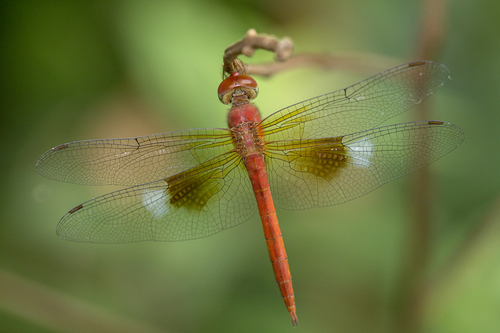
Twister
Tholymis tillarga
The ghost of the twilight garden, the Twister is a master of evening aerobatics. Known for its glowing white wing patches and vibrant red tail, it turns the sunset hour into a private airshow.
Quick Identification
Size
Total length of 42-45mm (1.6-1.8 inches); wingspan ranging from 75-84mm (2.9-3.3 inches).
Colors
Males have a brilliant coral-red abdomen and distinctive milky-white patches on the hindwings; females are an inconspicuous olive-brown with transparent wings.
Key Features
- Vibrant coral-red abdomen in mature males
- Milky-white patches on hindwings adjacent to dark brown spots
- Rapid, erratic 'twisting' flight pattern
- Crepuscular activity peaking at dawn and dusk
When You’ll See Them
Behavior
The Twister, or Coral-tailed Cloudwing, is famously known for its crepuscular lifestyle. Unlike many dragonflies that bask in the midday sun, the Twister spends the hottest hours of the day resting in deep shade or thick vegetation. As the sun begins to set, they emerge in large numbers, performing a rhythmic, erratic dance over water or open clearings to hunt and mate.
Their name 'Twister' comes from their unique flight style. They are incredibly agile, capable of sudden changes in direction that look like a spinning or twisting motion. They are often seen flying in 'shadow-zones'—under the canopy of trees or near the surface of ponds—where their white wing patches act like tiny beacons in the fading light. While they are generally solitary when resting, they can be found in loose aggregations during their peak evening flight.
EverydayEarth exclusive
Camera Tips
To capture the Twister on an AI-powered backyard camera, placement is everything. Since they are crepuscular, you should position your camera near a water source, such as a pond or birdbath, aiming the lens toward the western sky to catch the last rays of sunset. This backlighting will illuminate the male's milky-white wing patches, making them pop against a darkening background. Set your camera at a low angle, roughly 1 to 2 feet above the water surface, to catch them as they hover and dip.
Because the Twister is a fast mover, standard motion-trigger settings may miss the action. If your camera allows for it, use a 'High Frame Rate' or 'Slow Motion' mode. This is the only way to truly appreciate the 'twisting' flight mechanics that give this species its name. A camera with a fast shutter speed or a high-quality sensor is necessary to prevent the red abdomen from appearing as a blurry streak in the low evening light.
If you are struggling to get them to stay in frame, try adding 'perch sticks.' Place a few thin, vertical reeds or bamboo stakes around the edge of your pond. While Twisters spend most of their active time in the air, they will occasionally land for a few seconds to survey their territory. If your camera is pre-focused on the tip of one of these perches, you’ll get crystal-clear close-ups of their intricate wing venation and large compound eyes.
Finally, keep your camera active during overcast or foggy days. The Twister is one of the few dragonflies that actually prefers 'bad' weather. Their common name 'Foggy-winged Twister' comes from their tendency to fly when the air is thick with moisture. While other insects are hiding from the damp, the Twister is out hunting, giving you a unique opportunity to record wildlife activity when other cameras in the neighborhood are quiet.
Similar Species
Species that look similar or are commonly confused with Twister.
Frequently Asked Questions
Record Twister at your habitat
Connect a camera to start building your own species record — AI identifies every visitor automatically.