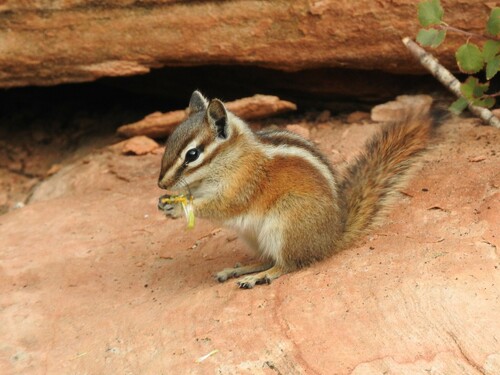
Uinta Chipmunk
Neotamias umbrinus
A high-altitude acrobat of the American West, the Uinta chipmunk thrives in the rugged pine forests of the Rocky Mountains. Known for its striking stripes and agile climbing, this 'hidden forest' resident is a favorite for backyard observers in mountain communities.
Quick Identification
Size
Total length 20–24 cm (7.9–9.5 in); weight 51–85 g (1.8–3.0 oz)
Colors
Brownish-gray upperparts with five dark and four light dorsal stripes; white underparts; black and white facial stripes with a distinct dark line through the eye.
Key Features
- Five dark dorsal stripes with the central one reaching the tail
- Distinct black and white facial masking
- Bushy, long tail often held vertically while running
- Larger and darker than the similar Least Chipmunk
When You’ll See Them
Geographic range
Where Does the Uinta Chipmunk Live?
Native to the mountain ranges of the western United States, the Uinta chipmunk is a true specialist of the Intermountain West. Its primary range encompasses the high-altitude regions of Utah, Wyoming, and Nevada, with significant populations also found in southern Idaho, western Colorado, and parts of California and Arizona. While it is endemic to this mountainous region, it is most frequently encountered in the Uinta and Wasatch Mountains, where the cool climate and abundant pine forests provide the perfect alpine sanctuary.
Basemap © OpenStreetMap contributors
Behavior
The Uinta chipmunk is a highly energetic and surprisingly arboreal member of the squirrel family. Unlike many of its cousins that stick strictly to the ground, the Uinta is a skilled climber, often seen foraging high in the canopies of Douglas fir and Ponderosa pine trees. They are diurnal, meaning they are most active during the daylight hours, spending their time harvesting seeds and defending small territories with a series of high-pitched chirps and 'chucks' that can alert other wildlife to the presence of predators.
These chipmunks are solitary by nature except during the breeding season. As winter approaches, they do not undergo true hibernation but instead enter a state of torpor. They retreat to underground burrows or nests hidden within hollow logs, waking periodically throughout the cold months to consume the vast caches of seeds they meticulously gathered during the summer and fall. Their interaction with humans is usually characterized by cautious curiosity, often approaching campsites or mountain decks if food is present, though they remain flighty and quick to retreat to cover.
EverydayEarth exclusive
Camera Tips
To capture the Uinta chipmunk on camera, focus on 'high-traffic' woodland corridors. Look for large, fallen logs or flat-topped boulders which these rodents use as lookout points and 'shucking' stations for their seeds. Mounting your camera about 12-18 inches off the ground, angled slightly downward toward a flat log surface, is the most effective way to get clear, eye-level shots. Because they are small and move incredibly fast, set your camera to a 'Burst' or 'Multi-shot' mode with the shortest possible trigger speed (0.2s or less) to avoid getting nothing but a blurry tail in the frame.
While we don't recommend feeding wildlife, placing a handful of native sunflower seeds or pine nuts in the center of a log can act as a natural 'stage' to keep them still for a few seconds. If you are in a backyard setting near a forest edge, positioning the camera near a water feature or a bird feeder will almost certainly yield results, as they are frequent visitors to easy water sources in the dry mountain air.
Lighting is crucial for these striped subjects. Try to position the camera so it faces north or south to avoid the harsh glare of the mountain sun, which can wash out the intricate patterns of their fur. Early morning and late afternoon are the best times for filming, as the 'golden hour' light makes their brownish-orange highlights pop. During the mid-winter months, your camera will likely see no activity, so plan your deployments between late spring and early autumn when the chipmunks are frantically prepping their winter caches.
Similar Species
Species that look similar or are commonly confused with Uinta Chipmunk.
Least Chipmunk
Smaller and paler with a more grayish-yellow tone; typically found in lower elevations and more open habitats like sagebrush.
Yellow-pine Chipmunk
Displays more vibrant cinnamon or tawny colors and is slightly smaller; prefers lower-elevation ponderosa pine forests.
Palmer's Chipmunk
Nearly identical in appearance but geographically isolated strictly to the Spring Mountains of southern Nevada.
Frequently Asked Questions
Record Uinta Chipmunk at your habitat
Connect a camera to start building your own species record — AI identifies every visitor automatically.