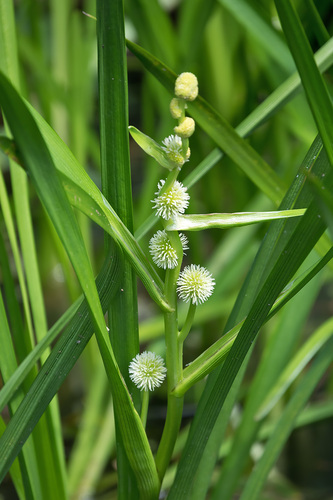
unbranched bur-reed
Sparganium emersum
A resilient architect of the water's edge, the unbranched bur-reed transforms shallow ponds into vibrant ecosystems with its iconic spiky flower balls and swaying, strap-like leaves.
Quick Identification
Size
Stems reaching 0.5–2 meters (1.6–6.6 feet) in length; leaves typically 6–12 mm wide.
Colors
Bright green foliage; white and yellow male flower clusters; spiky green female fruit balls that turn woody brown.
Key Features
- Unbranched flowering stem with spherical heads
- Flat, strap-like leaves with a triangular, keeled base
- Male flower balls positioned above the spiky female balls
- Perennial aquatic growth either floating or erect
When You’ll See Them
Geographic range
Where Does the unbranched bur-reed Live?
The unbranched bur-reed is a truly circumboreal species, blanketing the northern latitudes of the Northern Hemisphere. It is widely native across North America, flourishing from the subarctic reaches of Alaska and Canada down through the northern and central United States. Across the Atlantic, its range continues through nearly the entirety of Europe and northern Asia, making it one of the most widespread aquatic plants in temperate and boreal climates.
Basemap © OpenStreetMap contributors
Behavior
The unbranched bur-reed is a hardy aquatic perennial that serves as both a structural anchor and a biological filter for freshwater ecosystems. It demonstrates remarkable adaptability to its environment; in deeper or faster-moving water, its leaves remain limp and trail along the surface, while in shallow, still water, the leaves grow stiff and erect, standing tall above the waterline. This plant is monoecious, meaning a single plant hosts both male and female reproductive structures, though they are physically separated into distinct 'balls' along the stem.
Beyond its growth habits, the species is a vital neighbor to local wildlife. It provides essential cover for small fish and amphibians, while its nectar-rich male flowers attract a variety of pollinators during the summer months. For humans, it is a beneficial presence in backyard ponds and local streams, as it actively absorbs excess nutrients like phosphorus from the water, helping to prevent algae blooms and maintaining water clarity.
EverydayEarth exclusive
Camera Tips
Capturing the unbranched bur-reed requires a shift in strategy from traditional wildlife photography. Since plants move with the wind rather than their own volition, set your camera to 'Time Lapse' mode to document its life cycle. A photo taken every 6 hours during the summer will reveal the fascinating transition from submerged green shoots to the emergence of the distinctive spiky flower 'burs.' This is the best way to see the plant 'in action' without filling your SD card with motion-triggered videos of waving leaves.
If you prefer using motion triggers, place your camera on a sturdy stake or a low-profile tripod at the water's edge, aiming the lens at a 45-degree angle. This angle helps the AI distinguish the plant's unique triangular leaf bases from other aquatic grasses. To avoid 'false triggers' caused by moving water or wind-blown leaves, set your camera's PIR sensitivity to 'Low' and use a detection zone that focuses specifically on the upper flowering stalks where the movement is most predictable.
The unbranched bur-reed is a magnet for other species, making it an excellent 'stage' for your backyard camera. Position the lens to overlook a patch of bur-reed in a garden pond; you are likely to capture dragonflies using the stiff stalks as hunting perches or wood ducks seeking shelter among the leaves. The best lighting occurs during the 'golden hours' of early morning or late afternoon, which accentuates the texture of the spiky seed heads and the vibrant green of the foliage.
Similar Species
Species that look similar or are commonly confused with unbranched bur-reed.
Frequently Asked Questions
Record unbranched bur-reed at your habitat
Connect a camera to start building your own species record — AI identifies every visitor automatically.