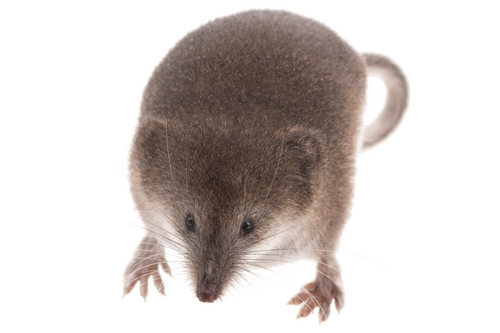
Vagrant Shrew
Sorex vagrans
The Vagrant Shrew is a tiny, high-velocity hunter that lives life in the fast lane, consuming its own body weight in prey every single day to fuel its relentless energy.
Quick Identification
Size
Length: 90–120 mm (3.5–4.7 in); Weight: 4–8 g (0.14–0.28 oz)
Colors
Dorsal fur is reddish-brown in summer and shifts to a darker, almost blackish-brown in winter; belly is typically light gray or silver.
Key Features
- Long, flexible pointed snout with sensitive whiskers
- Tail is roughly 1/3 of total body length and bicolored (darker above)
- Small, bead-like eyes and ears mostly hidden by fur
- Frenetic, rapid movements
When You’ll See Them
Geographic range
Where Does the Vagrant Shrew Live?
The Vagrant Shrew is a quintessential inhabitant of Western North America. Its native range extends from the southern reaches of British Columbia in Canada, down through the Pacific Northwest states of Washington and Oregon, and into California. It is also widely distributed throughout the Rocky Mountain region, including Idaho, Montana, Wyoming, and parts of Utah and Nevada. Because they require moist micro-climates, they are often found in localized 'islands' of habitat within drier regions.
Basemap © OpenStreetMap contributors
Behavior
Vagrant shrews are absolute dynamos of the undergrowth, possessing a metabolic rate so high that they must forage almost constantly to avoid starvation. They alternate between short bursts of intense activity and brief periods of rest throughout both day and night. While they have poor eyesight, they are expertly adapted to life in the leaf litter, using their highly developed senses of smell and touch—and even a primitive form of echolocation—to navigate and hunt.
These mammals are fiercely solitary and highly territorial. If two shrews encounter one another outside of the mating season, they often engage in vocal sparring, emitting high-pitched squeaks to ward off the intruder. They do not hibernate, staying active throughout the winter by tunneling through the subnivean zone (the space between the snow and the ground), where they continue their relentless search for dormant insects.
EverydayEarth exclusive
Camera Tips
To capture the Vagrant Shrew on a backyard camera, you must think at ground level. These tiny mammals rarely venture into the open, preferring the safety of 'travel corridors' under dense vegetation or along the edges of logs and rocks. Place your camera no more than 2 to 5 inches off the ground. Because of their size, you will need a camera with a close-focusing distance or a macro lens attachment; otherwise, the shrew will likely appear as a blurry brown smudge.
Standard PIR (Passive Infrared) sensors often fail to trigger for animals as small as a shrew because they don't give off enough heat. To combat this, use a 'camera trap' setup with a high-sensitivity setting and a fast trigger speed (under 0.2 seconds). Setting your camera to record short 5-10 second video clips is far more effective than still photos, as it allows you to observe their characteristic snout-twitching and rapid foraging movements which are often lost in a single frame.
Luring is highly effective for these hungry insectivores. A small amount of wet cat food or a smear of peanut butter mixed with birdseed placed directly in front of the lens will encourage them to pause. For the most natural shots, place the bait inside a hollow piece of bark or a small crevice in a rock to mimic their natural foraging behavior. During the winter, look for 'vent holes' in the snow near logs or foundations and place your camera there, as these are common exit points from their subnivean tunnels.
Frequently Asked Questions
Record Vagrant Shrew at your habitat
Connect a camera to start building your own species record — AI identifies every visitor automatically.