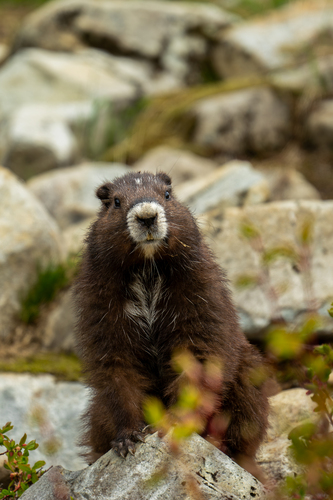
Vancouver Island Marmot
Marmota vancouverensis
The Vancouver Island Marmot is one of the world's rarest mammals, a charismatic 'whistle-pig' found only on the mountain peaks of British Columbia. With their chocolatey fur and social personalities, they are the undisputed icons of the Canadian sub-alpine.
Quick Identification
Size
Length of 65-70 cm (25-28 inches); weight ranges from 3.5 kg (7.7 lbs) in spring to 7 kg (15.4 lbs) before hibernation.
Colors
Rich chocolate-brown fur with distinct white patches on the nose, chin, and chest; older fur can fade to a cinnamon or rusty hue.
Key Features
- Deep chocolate brown coat
- White patches on muzzle and chest
- Large, bushy tail
- Powerful, stocky build with digging claws
When You’ll See Them
Behavior
Vancouver Island Marmots are highly social mammals that live in small colonies consisting of one or more family groups. They spend approximately seven months of the year hibernating in deep underground burrows to survive the harsh alpine winters. During their active season, they are famous for their 'nose-to-nose' greetings, which serve as a vital social bonding mechanism within the colony.
These marmots are often nicknamed 'whistle-pigs' due to their high-pitched alarm calls used to warn the colony of predators like cougars, wolves, or Golden Eagles. They spend a significant portion of their day basking on large rocks to regulate their body temperature and scanning the horizon for danger. They are gentle herbivores, spending the rest of their time foraging in lush meadows to build up the fat reserves necessary for their long winter sleep.
EverydayEarth exclusive
Camera Tips
To capture the Vancouver Island Marmot, you need to focus on high-elevation rocky outcrops and meadows. Since these marmots are most active when sun-basting, look for large, flat 'sentry rocks' that offer a panoramic view of the meadow. Mount your camera about 12-18 inches off the ground, aimed directly at the surface of these rocks. This low angle provides an intimate perspective on their social interactions and facial expressions.
Timing is everything with this species. Because they hibernate from late September until late April or early May, your window for photography is limited to the summer months. The best activity occurs during the mid-morning when they emerge to warm up after a cold mountain night. Set your camera to a fast trigger speed (0.3 seconds or less) to capture them before they duck into their burrows, and use a high-resolution photo burst mode to catch the subtle 'nose-kissing' social behavior.
Because this species is critically endangered, it is vital to avoid any form of baiting or luring. Instead of using food, place your camera along 'marmot runs'—well-trodden paths in the grass that lead from burrow entrances to foraging areas. Ensure your camera's PIR (Passive Infrared) sensor is set to high sensitivity, but try to clear any tall grasses directly in front of the lens to prevent false triggers caused by the mountain wind.
Lastly, consider the lighting conditions of the alpine environment. The chocolate-brown fur of the marmot can lead to underexposure against bright, sunlit rocks. If your camera has adjustable exposure settings, consider bumping it up slightly or using a wide dynamic range setting to ensure the dark fur shows detail. Hybrid mode, which captures a high-quality still followed by a 10-20 second video, is the best way to record their unique whistling vocalizations.
Similar Species
Species that look similar or are commonly confused with Vancouver Island Marmot.
Frequently Asked Questions
Record Vancouver Island Marmot at your habitat
Connect a camera to start building your own species record — AI identifies every visitor automatically.