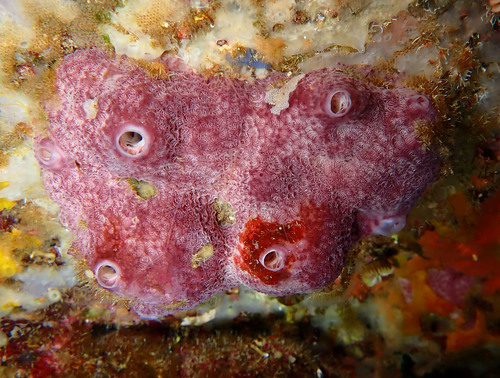
Variable Loggerhead Sponge
Ircinia variabilis
A master of Mediterranean reefs, the Variable Loggerhead Sponge is a resilient filter-feeder that transforms the seabed with its lobed shapes and shifting colors. A vital 'living pump,' it cleans the ocean while providing a home for countless tiny marine creatures.
Quick Identification
Size
Typically 10-25 cm (4-10 inches) in diameter and 2-5 cm (0.8-2 inches) thick, though encrusting forms can spread wider.
Colors
Highly variable, ranging from grayish-brown and violet to olive green or dull yellow; oscula (pores) often have dark-pigmented rims.
Key Features
- Irregular lobed or encrusting growth form
- Surface covered in tiny, pointed bumps called conules
- Large, visible exhalant pores (oscula) often concentrated on top
- Tough, leathery texture due to internal collagen filaments
When You’ll See Them
Geographic range
Where Does the Variable Loggerhead Sponge Live?
Native to the Mediterranean Basin, the Variable Loggerhead Sponge is a staple of the underwater landscape across Southern Europe and Northern Africa. Its core range extends from the rocky coastlines of Spain, Italy, and Greece into the warmer waters of the Levantine Sea, while also appearing in the eastern Atlantic Ocean along the coasts of Portugal and the Macaronesian islands like the Canaries and the Azores.
Basemap © OpenStreetMap contributors
Behavior
The Variable Loggerhead Sponge is a sessile organism, meaning it remains permanently attached to the seafloor or rocky substrates. Unlike animals that hunt, this sponge acts as a biological pump, constantly drawing water through its porous body to filter out microscopic nutrients. It plays a vital role in its ecosystem by cycling nutrients and providing a structural habitat for small crustaceans and worms that live within its internal canals.
Because it cannot move to escape predators, it relies on complex chemical defenses. It produces secondary metabolites that make it unpalatable or even toxic to many fish and sea urchins. Interestingly, it often forms symbiotic relationships with cyanobacteria, which live within its tissues and contribute to its coloration while providing additional energy through photosynthesis.
EverydayEarth exclusive
Camera Tips
Capturing the Variable Loggerhead Sponge requires an underwater setup, such as a waterproof action camera or a specialized reef-monitoring housing. Because these sponges are stationary, they are the perfect subjects for practicing underwater macro photography. To highlight the unique 'conules' (bumps) on their surface, position your camera at a 45-degree angle rather than shooting straight down; this creates shadows that reveal the sponge's complex texture.
If you are using an AI-powered camera in a tide pool or shallow reef, stability is key. Use a weighted tripod or a suction mount on a flat rock to prevent surge from blurring the image. Since sponges don't move, they are ideal candidates for time-lapse photography. A time-lapse over several hours can reveal the subtle expansion and contraction of the oscula (the large holes), showing the animal 'breathing' and pumping water.
Lighting is the biggest challenge when photographing *Ircinia variabilis*. As you go deeper, reds and yellows are filtered out by the water, making the sponge look dull gray or blue. Use a high-quality underwater video light or strobe to bring out the true violets and greens of the sponge. If you are monitoring a 'backyard' reef or dock piling, try to schedule your captures during midday when the sun is directly overhead for maximum natural light penetration.
Frequently Asked Questions
Record Variable Loggerhead Sponge at your habitat
Connect a camera to start building your own species record — AI identifies every visitor automatically.