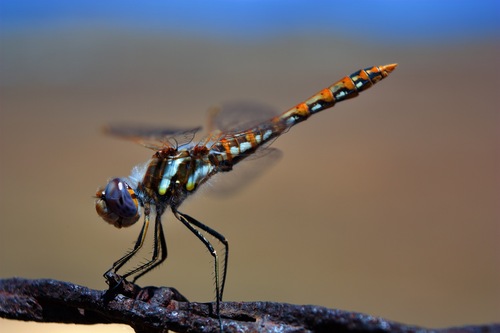
Variegated Meadowhawk
Sympetrum corruptum
A master of migration and a champion mosquito hunter, the Variegated Meadowhawk brings a splash of intricate color to sun-drenched gardens across North America. Watch for their unique mottled patterns as they bask on warm stones during the height of summer.
Quick Identification
Size
Length: 1.4 to 1.8 inches (36–45 mm); Wingspan: 2.4 to 2.8 inches (60–70 mm)
Colors
Mottled grey, tan, and brown base. Mature males develop bright red spots along the sides of the abdomen, while females and juveniles remain primarily golden-brown or grey.
Key Features
- Distinctive pale stripes on the side of the thorax ending in bright yellow dots
- Two-toned wing stigmas (spots near the tips) ranging from white to pink
- Variegated pattern of dark and light spots along the abdomen
- Often perches horizontally on the ground or low rocks rather than vertical stems
When You’ll See Them
Behavior
The Variegated Meadowhawk is a fascinating exception in the dragonfly world due to its migratory nature. While many dragonflies stay near the water where they hatched, these resilient flyers often travel long distances, appearing in backyard gardens far from any permanent pond. They are exceptionally hardy and are often the first dragonflies to arrive in the spring and the last to leave in the autumn, sometimes even active during warm spells in late winter.
Unlike some of their cousins who aggressively patrol territories, Variegated Meadowhawks are often seen perching on sunny surfaces to regulate their body temperature. They are 'perch-and-wait' hunters, sitting motionless on a garden path or a flat stone before darting out to snatch a flying insect from the air and returning to the same spot to consume their meal.
EverydayEarth exclusive
Camera Tips
Capturing high-quality images of Variegated Meadowhawks with an AI-powered camera requires a different strategy than filming birds or mammals. Because these dragonflies use 'obelisking' (lifting their abdomen) or basking to regulate temperature, they frequently land on flat, sun-exposed surfaces. Position your camera just 6 to 12 inches off the ground, aimed at a flat rock, a wooden garden stake, or even a patch of bare soil. These 'landing pads' are much more reliable than trying to catch them in mid-air.
Focus is the biggest challenge with small insects. If your camera has a macro mode or adjustable focal range, set it to its closest setting and ensure the 'landing pad' occupies the center of the frame. To attract them specifically, place a light-colored, flat stone in a spot that receives full sun for the majority of the day; the heat retention of the stone acts as a natural lure for these cold-blooded aviators. This is especially effective in the early morning when they are looking to warm up for their first flight.
Lighting is your best friend for showing off their intricate details. Position the camera so the sun is behind it or to the side, illuminating the dragonfly's complex wing venation and the red highlights on the male's abdomen. Since they are most active during the warmest parts of the day, midday is an excellent time for capture. If you are using a trail camera with a motion sensor, ensure the sensitivity is set to 'high,' as the small mass of a dragonfly may not always trigger standard sensors unless it lands very close to the lens.
Similar Species
Species that look similar or are commonly confused with Variegated Meadowhawk.
Blue Dasher
The Blue Dasher has a vibrant blue pruinose abdomen and green eyes, lacking the mottled red and tan patterns of the Variegated Meadowhawk.
Autumn Meadowhawk
Autumn Meadowhawks are smaller and males are a solid, uniform bright red rather than having the Variegated Meadowhawk's mottled appearance.
Frequently Asked Questions
Record Variegated Meadowhawk at your habitat
Connect a camera to start building your own species record — AI identifies every visitor automatically.