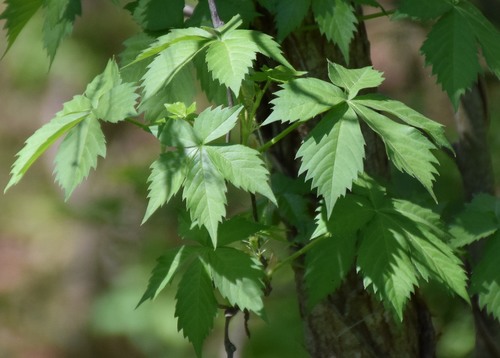
Virginia creeper
Parthenocissus quinquefolia
The ultimate multi-tasker of the backyard, Virginia creeper provides essential cover for nesting birds and a high-energy buffet of berries. Its iconic five-pointed leaves and brilliant red fall display make it a favorite for both wildlife and photographers.
Quick Identification
Size
Vines typically reach 30–50 feet (9–15 meters) in length; individual leaflets are 2–6 inches (5–15 cm) long.
Colors
Deep green foliage in summer, transitioning to brilliant scarlet, burgundy, or orange in autumn; small dark blue to black berries on red stalks.
Key Features
- Palmate leaves typically featuring 5 serrated leaflets
- Tendrils equipped with adhesive pads for climbing without twining
- Small, inconspicuous greenish-white flower clusters in spring
- Deep blue-black berries appearing in late summer and fall
When You’ll See Them
Behavior
Virginia creeper is a prolific deciduous climber known for its incredible versatility in the landscape. It uses specialized tendrils that end in tiny adhesive discs, allowing it to scale flat surfaces like stone, brick, and smooth bark without the need for support wires. Unlike some aggressive invasive vines, Virginia creeper is a North American native that coexists well with established trees, providing a lush vertical layer of habitat without strangling its host.
As a key player in the backyard ecosystem, this vine serves as a multi-purpose resource. During the spring and summer, its dense foliage offers hidden nesting sites for songbirds and a cool retreat for small mammals. In the autumn, it is one of the first plants to signal the change of seasons, turning a spectacular shade of crimson well before most trees begin to turn. This early color change acts as a 'fruit flag,' alerting migrating birds to the energy-rich berries hidden among its leaves.
EverydayEarth exclusive
Camera Tips
To capture the best wildlife action on Virginia creeper, focus your camera on the fruit clusters (berries) during late summer and autumn. These berries are a high-energy food source for over 35 species of birds, including eastern bluebirds, northern flickers, and cedar waxwings. Position your camera on a tripod roughly 4 to 6 feet away from a dense patch of berries, ensuring you have a clear line of sight. Use a high shutter speed if your camera allows, as birds often dart in and out quickly to grab a berry before retreating to cover.
Because Virginia creeper is a 'host plant' for several impressive sphinx moth species, it is a great candidate for nighttime insect photography. If your AI camera has a macro or close-focus setting, aim it at the underside of the leaves where large caterpillars may be feeding. Use a low-glow infrared flash to avoid startling any nocturnal visitors like opossums or raccoons that might be foraging for fallen fruit at the base of the vine.
One of the most rewarding ways to use a trail camera with this species is to set up a long-term time-lapse. Because the vine grows quickly and exhibits dramatic seasonal changes, capturing one photo per day at noon from September through November will provide a stunning record of the 'autumn burn.' Mount the camera to a stable post or nearby tree, ensuring it is angled to capture the full height of the vine against a wall or fence for maximum visual impact.
If you are looking to capture mammal activity, place your camera near the base of the vine at ground level. Thick patches of Virginia creeper provide excellent corridors for chipmunks, squirrels, and even foxes to move through a backyard undetected. Set the PIR (passive infrared) sensor sensitivity to high, as the movement of small rodents through the leaves can be subtle. Ensure you clear away any stray leaves directly in front of the lens to prevent 'false triggers' on windy days.
Frequently Asked Questions
Record Virginia creeper at your habitat
Connect a camera to start building your own species record — AI identifies every visitor automatically.