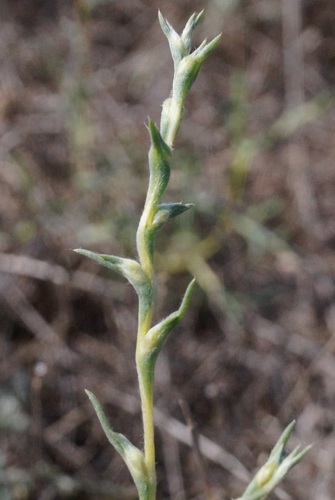
Volvox
Petrosimonia triandra
A master of the salt flats, the Volvox (Petrosimonia triandra) is a unique 'rolling' plant that thrives where others wither. Its geometric beauty and nomadic seed dispersal make it a fascinating subject for backyard nature observers.
Quick Identification
Size
Stands 10-40 cm (4-16 inches) tall with a spread of approximately 15-30 cm (6-12 inches).
Colors
Pale grayish-green foliage that often transitions to a vibrant reddish-brown or straw-yellow as the plant matures and dries in the autumn.
Key Features
- Succulent, alternate leaves with a fleshy texture
- Flowers featuring exactly three stamens
- Bushy, spherical growth habit that facilitates wind-rolling
When You’ll See Them
Behavior
The Volvox (Petrosimonia triandra), also known as the Three-Stamen Saltwort, is a specialized halophyte—a plant uniquely adapted to thrive in soils with high salt concentrations. Unlike typical garden plants, it utilizes a C4 photosynthetic pathway, allowing it to remain highly efficient during the hottest, driest parts of the day. Its growth behavior is characterized by a dense, branching structure that eventually forms a rounded, orb-like shape.
While it does not 'move' in the traditional animal sense during its growth phase, it exhibits a fascinating post-lifecycle behavior known as anemochory. Once the plant dies and dries out in the late autumn, the base of the stem weakens and snaps, allowing the entire structure to roll across the landscape as a tumbleweed. This 'rolling' behavior is a strategic social interaction with the environment, ensuring its seeds are distributed far and wide across the saline flats it calls home. Humans most often encounter these specimens in coastal regions or semi-arid alkaline basins.
EverydayEarth exclusive
Camera Tips
Capturing the Volvox (Petrosimonia triandra) on a trail camera requires a shift from traditional animal tracking to botanical time-lapse strategies. To document its growth, place your camera on a low tripod or ground mount, ideally only 5-10 inches off the dirt. Aim the lens horizontally to capture the plant's spherical silhouette against the horizon. For the best results, use a 'Time Lapse' mode set to one frame every 2-4 hours; this will allow you to see the plant 'inhale' and expand over the course of a summer season.
If you are interested in the 'active' rolling phase, you must adjust your PIR (Passive Infrared) sensors to their highest sensitivity. While plants don't emit heat, the movement of a dried Volvox rolling past the sensor on a windy autumn day can trigger the camera. Position your camera in an open 'bottleneck' of a salt flat or a fence line where wind-blown debris naturally accumulates. This is the best way to capture the dramatic movement that gives this species its 'rolling' reputation.
Lighting is crucial for this species. Because of its grayish-green hue, it can easily wash out in midday sun. Aim for a camera placement that puts the sun at a 45-degree angle to the plant to highlight the texture of its succulent leaves. If your camera has a macro-focusing capability, try to get within 2 feet of the plant during the flowering stage in late summer to document the tiny, three-stamened flowers that distinguish this species from its cousins.
Similar Species
Species that look similar or are commonly confused with Volvox.
Frequently Asked Questions
Record Volvox at your habitat
Connect a camera to start building your own species record — AI identifies every visitor automatically.