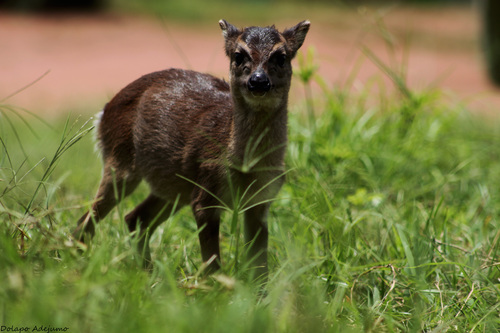
Walter's Duiker
Philantomba walteri
Discovered by science only in 2010, Walter's Duiker is a master of disguise in the West African undergrowth. This tiny, secretive antelope is a rare prize for any backyard wildlife enthusiast.
Quick Identification
Size
A diminutive antelope reaching 30-40 cm (12-16 inches) at the shoulder and weighing between 4 and 6 kg (9-13 lbs).
Colors
The coat is primarily a sleek, reddish-brown to dusky grey, with a slightly lighter underbelly and a dark tail fringed with white hairs.
Key Features
- Extremely small, hunched profile
- Short, spike-like horns angled backwards
- Prominent slit-like scent glands below the eyes
- Large, dark eyes and rounded ears
When You’ll See Them
Geographic range
Where Does the Walter's Duiker Live?
Native to the West African region known as the Dahomey Gap, Walter's duiker is primarily found in the countries of Togo, Benin, and southwestern Nigeria. It occupies the unique dry forest fragments that separate the wetter rainforests of Upper and Lower Guinea. While its precise range limits are still being studied due to its recent scientific description, it is considered a specialist of these specific transitional ecosystems.
Basemap © OpenStreetMap contributors
Behavior
Walter's duiker is a highly secretive and alert mammal that thrives in the dense cover of West African thickets. Primarily diurnal, it spends much of its day navigating established 'game trails' through the undergrowth, constantly sniffing the air and ground for food or predators. They are known for a characteristic 'diving' motion—from which the name 'duiker' (Dutch for diver) is derived—when they sense danger, plunging headlong into the thickest vegetation available.
Socially, Walter's duikers are mostly solitary or found in monogamous pairs. They are highly territorial, using the large preorbital glands under their eyes to rub a pungent secretion onto twigs and branches to mark their home range. While they generally avoid human contact, they can sometimes be found on the periphery of agricultural lands if there is sufficient forest cover nearby, though they remain one of the most difficult small ungulates to observe directly.
EverydayEarth exclusive
Camera Tips
To capture the elusive Walter's duiker, camera placement must be significantly lower than for most other wildlife. Set your AI-powered camera just 12 to 15 inches (30-40 cm) above the ground. Because these animals are small and stay low to the earth, a standard waist-high mount will often only capture the top of their heads or miss them entirely. Aim the camera at a slight downward angle along a clear 'tunnel' through dense brush.
Look for 'marking posts'—small, low-hanging twigs that appear slightly darker or waxy. These are often used by the duiker for scent marking. Placing a camera near these spots is your best chance for a clear facial shot. If you are monitoring a backyard or garden near a forest edge, they are most likely to visit during the quietest hours of the morning. Avoid high-traffic areas, as even the scent of domestic dogs can keep them away for days.
Since they are nervous and fast-moving, use the fastest trigger speed your camera allows. A burst mode of 3-5 photos or a short 15-second video clip is highly recommended. Video is particularly valuable for Walter's duiker, as the way they flick their tails and move their heads is often the only way to distinguish them from the very similar Maxwell's duiker in grainy light.
In terms of lures, they are naturally attracted to the scent of fallen wild fruit. If you have fruiting trees like wild figs or oil palms, focus your efforts there. Ensure your camera's infrared flash is set to 'No-Glow' or 'Invisible' mode; these duikers have excellent night vision and can be easily spooked by the faint red glow of standard LEDs, which may cause them to alter their trails.
Similar Species
Species that look similar or are commonly confused with Walter's Duiker.
Frequently Asked Questions
Record Walter's Duiker at your habitat
Connect a camera to start building your own species record — AI identifies every visitor automatically.