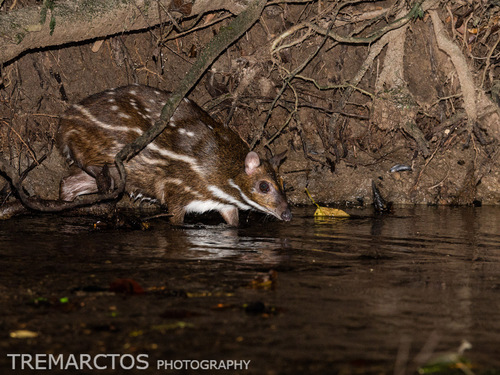
Water Chevrotain
Hyemoschus aquaticus
A mysterious 'fanged' inhabitant of the African rainforest, the Water Chevrotain is a master of the night and a surprising swimmer. Often called the 'mouse-deer,' this ancient species offers a rare glimpse into the prehistoric world of early hoofed mammals.
Quick Identification
Size
Length: 60-85 cm (24-33 in); Height: 30-40 cm (12-16 in); Weight: 7-15 kg (15-33 lbs)
Colors
Rich reddish-brown coat with a pattern of white horizontal stripes and rows of white spots along the flanks. The throat and belly are white, with distinct white markings on the neck.
Key Features
- Elongated upper canines (tusks) in males instead of antlers
- Distinctive white spots and stripes on a brown background
- Rounded, arching back with hindquarters higher than the shoulders
- Small, dainty legs supporting a stocky body
When You’ll See Them
Behavior
The Water Chevrotain is a shy, solitary mammal that is often referred to as a 'living fossil' due to its primitive features that have remained unchanged for millions of years. Unlike most ungulates, this species is highly dependent on water. When threatened by a predator, it will dive into a nearby stream or river and remain submerged or swim away to safety, utilizing its dense bones to help it stay underwater.
These animals are strictly nocturnal and lead a very private life in the dense undergrowth of the African rainforest. They are territorial, with females maintaining home ranges that rarely overlap with other females, while males typically occupy larger territories that encompass the ranges of several females. They communicate through a series of subtle vocalizations and scent marking.
EverydayEarth exclusive
Camera Tips
To capture the elusive Water Chevrotain, placement is everything. You must position your camera near the water's edge, particularly along well-worn 'game trails' that lead into thick brush or along the muddy banks of slow-moving streams. These animals follow the same paths repeatedly, so look for small, delicate hoof prints in the mud that look like miniature deer tracks.
Set your camera low to the ground—about 10 to 12 inches high. Because they are small and stay close to the forest floor, a high-mounted camera will likely miss them or only capture the top of their backs. Aim the camera across the path rather than directly down it to ensure the side-pattern of spots and stripes is visible, which is essential for clear identification.
Since they are strictly nocturnal, a high-quality infrared (no-glow) flash is mandatory. White flash may spook them and disrupt their natural behavior. Set your camera to a multi-shot burst or a short video mode (15-20 seconds). These animals move with a quick, nervous gait, and a single photo might result in a blur. Video is particularly rewarding as it may capture their unique 'bobbing' walk or their interaction with the water.
While they are primarily fruit eaters, using an aromatic fruit lure like dropped figs or seasonal rainforest fruits near the camera can encourage them to linger. However, in their natural habitat, simply finding a natural 'pinch point' between a dense thicket and a riverbank is often the most effective strategy.
Similar Species
Species that look similar or are commonly confused with Water Chevrotain.
Frequently Asked Questions
Record Water Chevrotain at your habitat
Connect a camera to start building your own species record — AI identifies every visitor automatically.