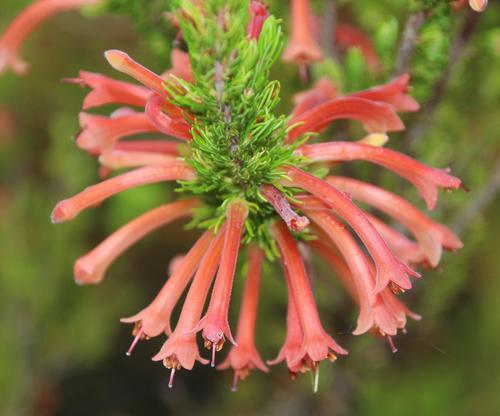
Water Heath
Erica curviflora
The Water Heath is a vibrant centerpiece of South Africa's wetlands, boasting fiery, curved blooms that serve as a natural nectar bar for local sunbirds.
Quick Identification
Size
A woody shrub reaching 1 to 1.5 metres (3.3 to 5 feet) in height, with tubular flowers measuring 25-40 mm (1-1.5 inches) in length.
Colors
Flowers are typically bright orange, fiery red, or sulfur yellow; foliage is a deep, matte green.
Key Features
- Long, downward-curved tubular flowers
- Needle-like evergreen leaves arranged in whorls of four
- Upright, multi-stemmed shrubby growth habit
- Found exclusively near water sources or in marshy ground
When You’ll See Them
Geographic range
Where Does the Water Heath Live?
The Water Heath is native to the African continent, found exclusively within the diverse fynbos ecosystem of South Africa's Western Cape. Its range is concentrated in the Cape Fold Mountains and the surrounding coastal plains, stretching from the Cederberg mountain range in the north down to the Cape Peninsula and across the Agulhas Plain. It is a true specialist of the 'Cape Floristic Region,' thriving only where there is a permanent source of moisture to satisfy its roots.
Basemap © OpenStreetMap contributors
Behavior
The Water Heath is a specialist of the fynbos biome, specifically adapted to thrive in nutrient-poor, acidic soils that remain consistently damp. Unlike many of its neighbors that are adapted for drought, this species acts as a riparian anchor, stabilizing stream banks and moist slopes. It follows a seasonal growth cycle, with a spectacular flowering display that peaks during the cooler, wetter months of the year.
Ecologically, the Water Heath is a vital nectar source for avian species. Its flowers have evolved a specific curvature that perfectly matches the bill shape of sunbirds, particularly the Orange-breasted Sunbird and the Southern Double-collared Sunbird. This symbiotic relationship ensures the plant is pollinated while the birds receive a high-energy food source during the winter and spring.
EverydayEarth exclusive
Camera Tips
Capturing the Water Heath on camera requires a focus on its ecological visitors rather than just the plant itself. Position your camera on a tripod at roughly 1 metre (3 feet) in height, focusing on a cluster of vibrant, open blooms. Because sunbirds move with incredible speed, use a fast shutter speed (at least 1/1000s) or a dedicated 'Sports Mode' to avoid motion blur. If your camera allows for it, a macro lens will capture the beautiful waxy texture and fine hairs on the tubular petals.
Since this plant is usually found in damp environments, pay close attention to your camera's weather sealing. Early morning light is particularly flattering, as the 'golden hour' sun illuminates the translucent orange and red flowers, making them appear to glow against the darker green background of the fynbos. Look for plants with multiple open bells, as these are the ones most likely to attract repeated visits from local sunbirds and sugarbirds.
If you are using a motion-triggered trail camera, set the trigger sensitivity to high and the burst mode to 3-5 photos per trigger. Sunbirds often hover for only a second or two while feeding, and a slow trigger speed will result in many photos of empty branches. Positioning the camera to the south of the plant (in the Southern Hemisphere) will ensure the sun is behind you, providing the best natural lighting on the flower faces throughout the day.
Frequently Asked Questions
Record Water Heath at your habitat
Connect a camera to start building your own species record — AI identifies every visitor automatically.