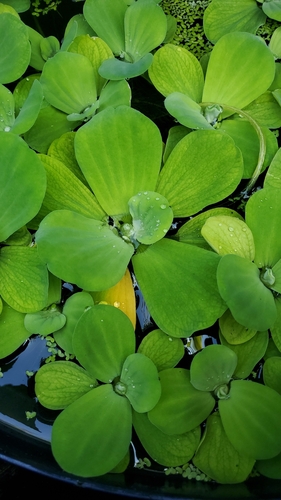
Water Lettuce
Pistia stratiotes
Meet nature's floating filter. Water Lettuce creates striking green rosettes that drift across the water, providing a sanctuary for frogs and fish while naturally cleaning your backyard pond.
Quick Identification
Size
Rosettes typically range from 5–15 cm (2–6 inches) in diameter, though they can reach up to 30 cm (12 inches) in high-nutrient environments.
Colors
Soft, pale pea-green to lime-green leaves with a silvery-white or grayish tint caused by dense, microscopic hairs.
Key Features
- Floating rosette structure resembling a head of garden lettuce
- Thick, velvety leaves with distinct longitudinal ridges or veins
- Dense network of feathery, light-colored roots trailing underwater
- Lack of visible stems; leaves emerge from a central growing point
When You’ll See Them
Behavior
Water Lettuce is a free-floating perennial that functions as a mobile ecosystem. It doesn't remain stationary but drifts with wind and water currents, often congregating in large, interlocking mats. It is a master of vegetative reproduction; it sends out horizontal runners known as stolons, which quickly sprout 'daughter' plants, allowing a single specimen to colonize an entire pond surface in a matter of weeks during the peak of summer.
While often viewed as an invasive pest in large-scale waterways due to its ability to block boat traffic and deplete oxygen, it is a highly active biological filter. In a backyard setting, it acts as a 'nutrient sponge,' aggressively absorbing nitrates and phosphates that would otherwise fuel toxic algae blooms. For local wildlife, these floating rosettes serve as critical infrastructure, providing shade for fish and sturdy platforms for semi-aquatic insects and amphibians.
EverydayEarth exclusive
Camera Tips
Capturing the life of Water Lettuce requires a shift in how you think about AI camera triggers. Because the plant moves slowly with the wind, typical motion sensors may either ignore it or trigger constantly. The most rewarding way to document this species is by using a time-lapse setting. Place your camera on a fixed mount—like a tripod or a low-profile stake at the pond’s edge—and set it to take one photo every 30 to 60 minutes. When played back, you can see the fascinating 'march' of the stolons as they reach out to colonize open water.
For the best visual results, position the camera as low to the water's surface as possible. A 'frog's eye view' creates a dramatic landscape where the rosettes look like a miniature floating forest. This angle is also perfect for catching the 'lotus effect' on the leaves. The microscopic hairs on Water Lettuce trap air, making them extremely water-repellent. After a rainstorm or morning dew, the AI camera can capture stunning imagery of water sitting in perfect, shimmering spheres on the leaves, which looks professional and high-end.
Water Lettuce is a magnet for other wildlife, making it a great 'bait' for your camera without using food. Position your lens to focus on a large, stable cluster of rosettes near the shore. Frogs, dragonflies, and small turtles frequently use these mats for sunbathing or hunting. By focusing on the plant, you are essentially setting up a stage for these animals. Ensure your camera is set to a fast shutter speed if the water is moving, as this prevents the fine ridges on the leaves from appearing blurred.
Managing light is the final hurdle for aquatic photography. The reflective surface of the water can cause 'hot spots' or glare that washes out the green of the leaves. To avoid this, try to angle your camera so it isn't facing the sun directly, or use the natural shade of overhanging trees to diffuse the light. Early morning and late afternoon (the golden hours) are the best times to capture the depth of the leaf ridges and the intricate, feathery details of the roots if your camera is submerged or close to the surface.
Similar Species
Species that look similar or are commonly confused with Water Lettuce.
Frequently Asked Questions
Record Water Lettuce at your habitat
Connect a camera to start building your own species record — AI identifies every visitor automatically.