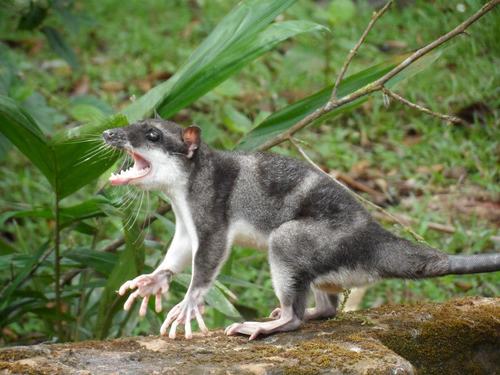
Water Opossum
Chironectes minimus
Meet the world's only aquatic marsupial, a nocturnal master of the river with waterproof fur and webbed feet. Elusive and striking, the Water Opossum is the ultimate prize for backyard explorers living near the water's edge.
Quick Identification
Size
Body length 27–40 cm (10–16 in), tail length 31–43 cm (12–17 in); weight 600–800 g (1.3–1.8 lbs)
Colors
Distinctive high-contrast pattern of four or five broad blackish-brown bands over a pale gray or white base; white underbelly; dark facial mask across the eyes
Key Features
- Broadly webbed hind feet for powerful swimming
- Unique waterproof pouch present in both males and females
- Short, dense, water-repellent fur
- Thick, cylindrical tail used as a rudder
When You’ll See Them
Geographic range
Where Does the Water Opossum Live?
The Water Opossum is native to the Neotropical realm, spanning from the southern regions of Mexico through Central America and deep into South America as far as northeastern Argentina. It is a lowland specialist that thrives across the Amazon Basin, the Guianas, and the Atlantic Forest. While it covers a vast geographic area, its distribution is fragmented and strictly tied to the presence of clean, permanent freshwater sources.
Basemap © OpenStreetMap contributors
Behavior
The Water Opossum, or Yapok, is a remarkable evolutionary outlier: it is the world's only truly semiaquatic marsupial. Almost exclusively nocturnal, it spends its nights navigating freshwater streams and lakes with surprising agility. While it moves with a somewhat clumsy waddle on land, it is a master of the water, using its powerful, webbed hind feet to propel itself while its long, hairless tail acts as a precision rudder.
These animals are solitary and highly territorial, living in burrows dug into riverbanks with entrances just above the water line. One of their most fascinating biological traits is the pouch; in females, a strong sphincter muscle seals the pouch completely, keeping the young dry even when the mother is diving for food. Males also possess a pouch, which they use to protect their genitalia from cold water and tangled vegetation while swimming.
Because of their strictly nocturnal habits and preference for dense riparian cover, they are rarely seen by humans. They are sensitive to water pollution and habitat degradation, meaning their presence is often a sign of a healthy, clean freshwater ecosystem. In areas where human development nears their streams, they may occasionally pass through backyard gardens that border natural waterways.
EverydayEarth exclusive
Camera Tips
Capturing the elusive Water Opossum requires a strategic water-side setup. Unlike terrestrial opossums, the Yapok will rarely venture far from the shoreline. Position your camera on a sturdy stake or tree trunk roughly 1 to 2 feet above the ground, angled downward toward the edge of a slow-moving stream or a shallow riverbank where the animal might climb out to groom or consume its catch. Look for small, flattened areas of vegetation or muddy tracks near the water's edge to identify potential entry and exit points.
Since this is a strictly nocturnal species with a dark, light-absorbing coat, high-quality infrared (IR) flash is essential. Set your camera to a high trigger sensitivity and use 'Burst Mode' or short video clips (15–20 seconds). These animals move quickly in the water, and video is often the best way to distinguish their unique swimming motion from that of a common rodent or an otter. If your camera supports it, high-definition video with audio can capture the distinct splashing sounds they make while foraging.
Baiting for Water Opossums is tricky because they prefer live aquatic prey. However, some researchers have had success using oily fish or pungent sardines in mesh bags secured near the water's edge. Because they use their front paws to feel for food, placing the bait in shallow water (2–4 inches deep) can encourage the animal to stay in the camera's frame longer as it investigates. Ensure your equipment is properly waterproofed, as seasonal rains can cause the water levels of their preferred habitats to rise rapidly.
Similar Species
Species that look similar or are commonly confused with Water Opossum.
Frequently Asked Questions
Record Water Opossum at your habitat
Connect a camera to start building your own species record — AI identifies every visitor automatically.