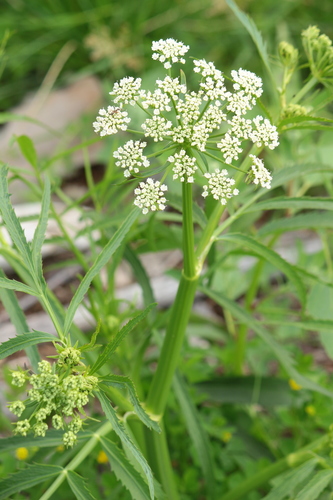
water parsnip
Sium suave
A statuesque wetland beauty, water parsnip lights up the water's edge with delicate white lace. It is a vital sanctuary for pollinators and a favorite host for the stunning Black Swallowtail butterfly.
Quick Identification
Size
Stands 2 to 6 feet (60–180 cm) tall with a spread of 1 to 3 feet (30–90 cm).
Colors
Bright green stems and foliage; clusters of tiny, brilliant white flowers; occasional reddish tint on lower stems.
Key Features
- Hollow, strongly ridged stems
- Once-pinnate leaves with 7-17 narrow, sharply serrated leaflets
- Flat-topped white flower clusters (umbels) up to 4 inches wide
- Cross-veins on leaves that do not end in the notches of teeth.
When You’ll See Them
Behavior
Water parsnip is a resilient perennial that acts as a structural anchor in wetland ecosystems. It spends the early spring as a submerged or semi-submerged rosette before sending up tall, hollow stalks as the season warms. Unlike many terrestrial plants, it has a fascinating ability to change its leaf shape based on water levels; leaves that grow underwater are often much more finely dissected and feathery than the solid leaflets found above the waterline.
While it may look delicate, this plant is a powerhouse for local biodiversity. It serves as a primary host plant for the Eastern Black Swallowtail butterfly larvae and attracts a dizzying array of native bees, predatory wasps, and hoverflies to its nectar-rich umbels. Because it thrives in mucky, saturated soil, it often forms dense colonies that provide excellent cover for small amphibians and aquatic insects near the shore.
EverydayEarth exclusive
Camera Tips
Capturing the water parsnip on a trail camera requires a strategy that focuses on its visitors rather than just the plant itself. Because it grows in saturated soil, ensure your camera mount is stable—auger-style stakes work better in muck than standard tripods. Position your camera at a slight upward angle, roughly 2-3 feet off the ground, to catch the underside of the flower umbels where many pollinators and predatory insects hang out. If you are looking to capture the iconic Black Swallowtail caterpillars, focus your lens on the mid-section of the stems where the foliage is densest.
Time-lapse mode is the secret weapon for this species. Set your camera to take a photo every 15-30 minutes during the peak blooming months of July and August. This will allow you to see the 'umbel' transition from a tight green bud into a white explosion of flowers. For those interested in wildlife interactions, place your camera with a wide-angle setting about 5 feet away from a cluster of water parsnip; this frequently captures frogs and turtles navigating the shade at the base of the plants.
Lighting is crucial in wetland environments where glare from the water can wash out your images. Position your camera facing North or South to avoid the direct 'hot' light of the rising or setting sun reflecting off the water. Use a fast shutter speed if your camera allows, as the hollow stems of the water parsnip tend to sway significantly in even a light breeze, which can cause motion blur in lower-end sensors. If your camera has a 'macro' or close-focus setting, use it to get within 18 inches of a bloom for high-detail shots of visiting solitary bees.
Similar Species
Species that look similar or are commonly confused with water parsnip.
Frequently Asked Questions
Record water parsnip at your habitat
Connect a camera to start building your own species record — AI identifies every visitor automatically.