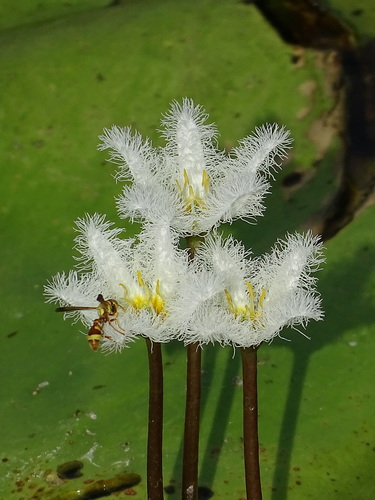
Water Snowflake
Nymphoides indica
Adorn your pond with the delicate, fringed beauty of the Water Snowflake, a resilient aquatic plant that transforms water surfaces into a winter wonderland of white blooms. Its unique star-shaped flowers and lily-pad leaves provide the perfect habitat for a thriving backyard aquatic ecosystem.
Quick Identification
Size
Leaves 5–20 cm (2–8 in) wide; flowers 2–3 cm (1 in) diameter; stems can reach 2-3 meters in length depending on water depth
Colors
Snow-white petals with a dense fringe of fine white hairs; bright yellow centers; bright green to reddish-tinged heart-shaped leaves
Key Features
- Star-shaped white flowers with distinctively fringed (feathery) petals
- Heart-shaped floating leaves resembling miniature water lilies
- Abundant yellow-centered blooms held just above the water surface
- Bundles of submerged tubers that look like miniature green bananas
When You’ll See Them
Geographic range
Where Does the Water Snowflake Live?
Where Does the Water Snowflake Live? This aquatic beauty is a truly global citizen of the tropics and subtropics, with a native range spanning through Africa, much of southern and eastern Asia, and across Australia. In the Western Hemisphere, it is naturally found throughout Central and South America and has established significant introduced populations in the southern United States, most notably in the warm wetlands of Florida. It thrives in shallow, nutrient-rich waters where its roots can reach the muddy bottom while its leaves dance on the surface.
Basemap © OpenStreetMap contributors
Behavior
The Water Snowflake is a vigorous perennial aquatic plant celebrated for its prolific blooming cycle. Unlike many water lilies that bloom sporadically, a healthy Nymphoides indica can produce dozens of flowers simultaneously, creating a carpet of white across the water surface. The flowers are ephemeral, often opening with the morning sun and fading by the late afternoon, but the plant continuously produces new buds throughout the warm season.
Ecologically, the plant plays a vital role in pond ecosystems. Its broad floating leaves provide shade that keeps water temperatures stable and offers a sanctuary for fish and aquatic insects from predators. While it is a popular choice for backyard water gardens, its rapid growth via submerged runners allows it to colonize new areas quickly, occasionally becoming dense enough to outcompete other aquatic vegetation in tropical climates.
EverydayEarth exclusive
Camera Tips
To capture the intricate beauty of the Water Snowflake, your AI camera should be positioned as close to the water's surface as possible. A low-angle shot looking across the lily pads captures the depth of the delicate, snowflake-like fringe on the petals that a standard top-down shot might miss. Because the flowers are a brilliant, reflective white, they can easily wash out in bright midday sun; setting your camera to trigger during the softer light of mid-morning or under light cloud cover will preserve the subtle textures of the bloom.
Since this is a stationary species, the most rewarding way to document it is through time-lapse photography. Set your camera to take an image every 15 to 30 minutes from dawn until dusk. This allows you to observe the unique 'waking up' process as the flowers unfurl in the morning light and close by evening. This technique also captures the various 'visitors' to the plant, such as dragonflies using the leaves as hunting perches or bees navigating the yellow centers for nectar.
For backyard pond enthusiasts, mount your camera on a stable stake or a floating dock to prevent vibrations from water movement. If you are using an AI-powered camera like those featured on EverydayEarth, try to frame the shot so a single cluster of flowers is the primary focus. This helps the AI better identify the species and allows you to track the health of the plant over the season as new leaves emerge from the central root structure.
Frequently Asked Questions
Record Water Snowflake at your habitat
Connect a camera to start building your own species record — AI identifies every visitor automatically.