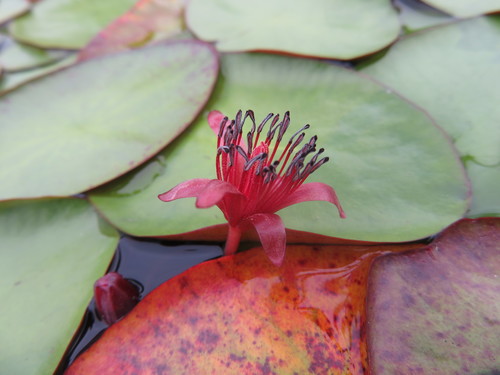
Watershield
Brasenia schreberi
The Watershield is a master of pond geometry, featuring perfectly oval floating leaves and a mysterious gelatinous coating. Often called 'water-target,' this ancient plant provides a shimmering stage for frogs and dragonflies in quiet backyard waters.
Quick Identification
Size
Leaves are 5–13 cm (2–5 in) long; stems can reach lengths of up to 2 meters (6.5 ft) depending on water depth.
Colors
Bright green upper leaf surface; deep maroon or purple undersides, stems, and flowers.
Key Features
- Perfectly oval floating leaves with no notch
- Thick, gelatinous slime coating submerged parts
- Leaf stalk attached to the center of the blade (peltate)
- Small, dark purple flowers about 1 inch wide
When You’ll See Them
Behavior
During the peak of summer, Watershield performs a unique reproductive dance. The small, dull-purple flowers emerge from the water on long stalks over a two-day period. On the first day, the female organs (carpels) extend to receive wind-blown pollen. On the second day, the flower rises again, but this time it extends its male organs (stamens) to release pollen into the air. Once pollination is complete, the stalk recoils, pulling the developing fruit beneath the surface to mature in the safety of the water.
EverydayEarth exclusive
Camera Tips
Capturing the beauty of Watershield requires a focus on time-lapse and macro perspectives. To document its unique flowering cycle, set your AI-powered camera on a stable tripod at the water's edge or on a low-profile dock. Because the flowers only emerge for two days and are relatively small, a time-lapse setting—capturing one frame every 10 to 15 minutes—is the best way to visualize the plant 'breathing' as the leaves shift and the flowers rise and fall. Use a polarizing filter on your lens if possible; this is essential for cutting through the water's surface glare and revealing the deep purple stems and the shimmering gelatinous coating hidden just below the surface.
For the best lighting, aim for the 'Golden Hours' of early morning or late afternoon. The low-angled sun creates a beautiful rim-light effect on the oval edges of the leaves, highlighting the water droplets that often bead up on their waxy, water-repellent surface. If you are using a trail camera with motion activation, be aware that wind and ripples can cause 'false triggers.' Set your camera’s sensitivity to a medium level or use a 'hybrid' mode that combines PIR (passive infrared) sensing with timed intervals to ensure you get consistent footage of the plant even when there is no animal movement.
Watershield patches are high-traffic zones for backyard wildlife, which adds a layer of excitement to your footage. Frogs frequently use the leaves as 'lily pads' for sunning, and dragonflies use the stems as perches for hunting. To capture these interactions, angle your camera at a 45-degree slope toward a cluster of leaves about 3-5 feet away. This 'sweet spot' distance allows the AI to recognize visitors like Green Frogs or Painted Turtles while keeping the architectural elegance of the Watershield in sharp focus. If your camera allows for macro focus, try a close-up shot of a single leaf to capture the incredible symmetry of its central stalk attachment.
Frequently Asked Questions
Record Watershield at your habitat
Connect a camera to start building your own species record — AI identifies every visitor automatically.