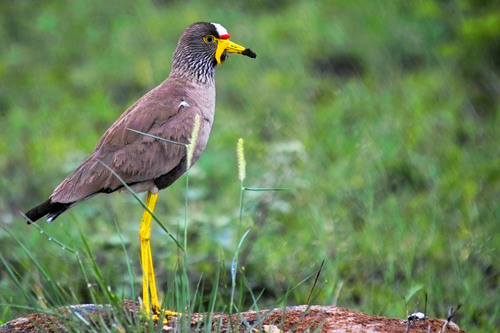
Wattled Lapwing
Vanellus senegallus
The Wattled Lapwing is the striking, yellow-masked guardian of the African landscape. Known for its bold personality and piercing calls, this elegant wader is a favorite for backyard birders and wildlife photographers alike.
Quick Identification
Size
Length: 34–35 cm (13–14 in); Wingspan: 80–85 cm (31–33 in); Weight: 160–300 g (5.6–10.6 oz)
Colors
Brownish-grey upperparts and breast; white forehead and crown; long, pendulous yellow wattles with red bases; yellow legs; white wing bar visible in flight.
Key Features
- Large yellow facial wattles with red upper tips
- Distinctive white forehead and crown patch
- Long yellow legs and bill with a black tip
- Loud, piercing 'peep-peep' alarm call
When You’ll See Them
Behavior
Socially, they are most often seen in pairs or small family groups, though they may congregate in larger loose flocks near water sources during the dry season. They are famous for their role as the 'sentinels' of the bush; their loud, clattering alarm calls often alert other wildlife to the presence of predators. In suburban environments, they have adapted well to large gardens, golf courses, and parklands where the grass is kept short.
EverydayEarth exclusive
Camera Tips
Water is a major draw for this species. If you have a shallow birdbath or a garden pond with a muddy edge, aim your camera there. They frequently visit these spots to drink and bathe during the hottest parts of the day. Because they are attracted to areas with high insect activity, keeping a portion of your garden organic and pesticide-free will naturally increase the frequency of their visits as they forage for worms and beetles.
Regarding camera settings, the Wattled Lapwing is a fast mover. Use a high shutter speed or a 'sports' mode if your AI camera allows it, as their sudden dashes for insects can result in motion blur on slower settings. Burst mode is highly recommended; catching a sequence of photos often reveals interesting behaviors like 'foot-trembling' to lure insects to the surface. Since they are most active in the golden hours of dawn and dusk, ensure your camera's low-light sensitivity is optimized to capture their subtle brown and grey plumage without losing detail.
During the breeding season, look for them in the same spot daily, as they are strictly territorial. However, never place a camera directly on a nest, as this can attract predators or cause the birds to abandon their eggs. Instead, monitor the perimeter of their territory. Their loud calls are a great indicator that you’ve placed your camera in a high-traffic zone for them.
Similar Species
Species that look similar or are commonly confused with Wattled Lapwing.
Blacksmith Lapwing
Lacks facial wattles and has a striking black, white, and grey 'piebald' color pattern.
Crowned Lapwing
Smaller with red legs and a distinctive black cap with a white ring, lacking the yellow wattles.
Spur-winged Lapwing
Has a black crown and throat with a brownish back, and lacks the yellow wattles of the Wattled Lapwing.
Frequently Asked Questions
Record Wattled Lapwing at your habitat
Connect a camera to start building your own species record — AI identifies every visitor automatically.