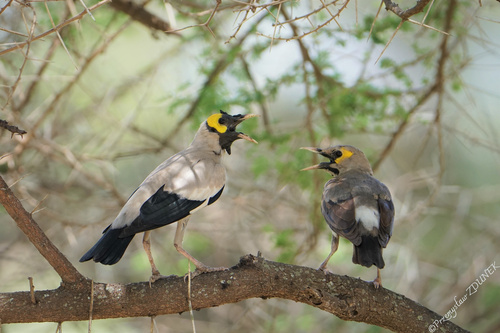
Wattled Starling
Creatophora cinerea
The Wattled Starling is Africa's nomadic 'locust bird,' famous for the male's bizarre and striking breeding ornaments. Watch as these social travelers follow the rains and transform your backyard into a bustling insect-hunting ground.
Quick Identification
Size
Length: 21 cm (8.3 in); Weight: 64–81 g (2.3–2.9 oz)
Colors
Primary body is pale grey; wings and tail are black. Breeding males feature bald yellow facial skin and large black fleshy wattles.
Key Features
- Breeding males have prominent black fleshy wattles on the throat and crown
- Bald yellow and black facial skin
- Pale grey plumage with contrasting black wings
- Highly nomadic and social flocking behavior
When You’ll See Them
Behavior
Wattled Starlings are the great nomads of the African skies. Unlike many of their more sedentary starling cousins, these birds follow the rains and insect outbreaks across the continent. They are famously known as 'locust birds' because of their tendency to descend in massive flocks upon areas experiencing grasshopper or locust swarms, providing a natural form of pest control for local farmers.
Social to the core, they are rarely seen alone. They forage in busy, chattering groups, often walking with a purposeful, jerky gait through short grass. In the backyard or farm environment, they are frequently seen trailing behind livestock, expertly snatching up the insects disturbed by the animals' movement. While they are less vocal than other starlings, their presence is marked by a constant, low-level rustling and soft whistling calls within the flock.
EverydayEarth exclusive
Camera Tips
To capture the Wattled Starling on your backyard or trail camera, you need to think like an insect hunter. These birds are terrestrial foragers, so your camera should be mounted low—ideally between 12 and 24 inches off the ground—pointing toward an open patch of lawn or short grass. If you have a birdbath, this is the gold standard for placement. In the dry regions they inhabit, a reliable water source is an irresistible magnet that will slow them down enough for a clear shot.
Because they are nomadic, you may not see them for months, and then suddenly have fifty in your yard. To make the most of these visits, set your camera to 'Burst Mode' or 'Photo + Video.' They are incredibly fast and social; a single photo rarely captures the chaotic energy of a flock. If your camera allows for sensitivity adjustments, set it to high, as their pale grey plumage can sometimes blend into a bright, overexposed background, making them harder for some PIR sensors to distinguish.
If you are looking to attract them specifically, offer mealworms or high-protein suet on a ground-level tray. Unlike the iridescent Cape Starling, the Wattled Starling is more cautious, so ensure your camera is well-camouflaged and not placed in a high-traffic human area. The best time for lighting is the 'golden hour' shortly after sunrise, which perfectly illuminates the yellow skin on the breeding males' heads without causing harsh shadows from their wattles.
Similar Species
Species that look similar or are commonly confused with Wattled Starling.
Frequently Asked Questions
Record Wattled Starling at your habitat
Connect a camera to start building your own species record — AI identifies every visitor automatically.