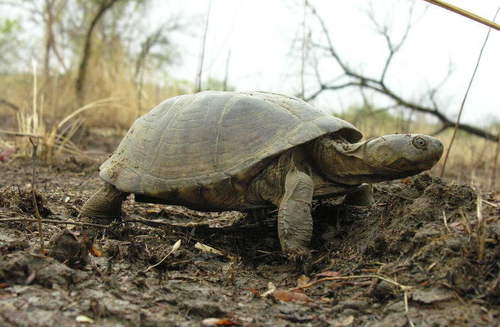
West African Mud Turtle
Pelusios castaneus
A master of the African marshes, the West African Mud Turtle is famous for its unique side-folding neck and its ability to survive the harshest dry seasons buried deep in the mud.
Quick Identification
Size
Carapace length 20-28 cm (8-11 inches); weight 1-2.5 kg (2.2-5.5 lbs)
Colors
Dark brown to blackish carapace; yellowish plastron with dark blotches; grey-olive head with fine yellow marbling
Key Features
- Hinged plastron allowing the front of the shell to close
- Side-neck retraction (folds neck sideways)
- Smooth, oval-shaped dark carapace
- No nuchal scute at the front center of the shell
When You’ll See Them
Geographic range
Where Does the West African Mud Turtle Live?
This species is a quintessential resident of West and Central Africa, spanning a vast territory from Senegal in the west to the Central African Republic in the east. It is most frequently encountered in the coastal and inland wetlands of countries such as Nigeria, Ghana, Ivory Coast, and Cameroon. While its heartland is the African continent, introduced populations have also established themselves in the Caribbean, particularly in Guadeloupe.
Basemap © OpenStreetMap contributors
Behavior
The West African Mud Turtle is a resilient freshwater specialist characterized by its 'side-neck' anatomy. Unlike many common turtles that pull their heads straight back, this species tucks its head and neck sideways under the protective rim of its shell. They are moderately social and can often be found congregating in high numbers in favorable wetlands, though they remain wary of humans and will dive quickly if they sense vibrations from approaching footsteps.
A fascinating aspect of their behavior is 'aestivation.' During the intense dry seasons of West Africa, when smaller pools and streams evaporate, these turtles burrow into the damp mud at the bottom of the water body. They enter a state of dormancy, slowing their metabolism significantly until the return of the rainy season triggers their emergence. They are most active and visible during the wet months when they move between water sources.
EverydayEarth exclusive
Camera Tips
To capture the West African Mud Turtle on camera, focus your efforts on basking locations. These turtles must regulate their body temperature, so look for partially submerged logs, flat rocks, or muddy banks that receive direct sunlight between 8 AM and 11 AM. Position your camera at a very low angle, no more than 15 centimeters (6 inches) off the ground, to get an intimate perspective of their head markings and shell texture.
Because turtles are ectothermic, they may not always trigger standard PIR (Passive Infrared) motion sensors, especially if their body temperature matches the environment. For the best results, use a camera with a 'Time Lapse' mode set to take a photo every 1-2 minutes during peak sun hours, or increase the motion sensitivity to its highest setting. Placing the camera near a shallow 'exit ramp' of a pond where the turtle naturally hauls itself out of the water is a high-traffic strategy.
If you are monitoring them at night, use a 'No Glow' infrared flash. These turtles have excellent vision and can be startled by the red glow of standard IR LEDs, causing them to retreat into the water. If you are trying to attract them to a specific spot for a backyard camera setup, a small amount of protein-heavy bait like dried shrimp or sardines in a perforated container can encourage them to linger in the frame for a perfect shot.
Frequently Asked Questions
Record West African Mud Turtle at your habitat
Connect a camera to start building your own species record — AI identifies every visitor automatically.