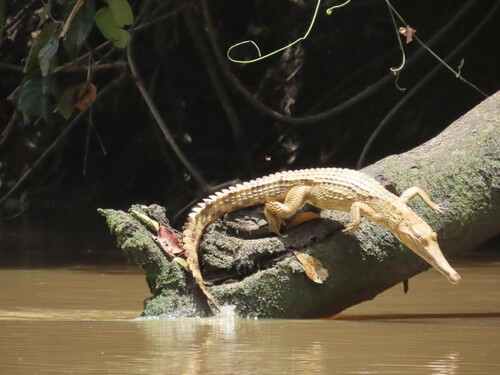
West African slender-snouted crocodile
Mecistops cataphractus
The West African slender-snouted crocodile is a master of camouflage and a symbol of the pristine rainforest waterways it inhabits. This critically endangered reptile is as elusive as it is ancient, identifiable by its uniquely thin snout designed for expert fishing.
Quick Identification
Size
2.5 to 4 meters (8.2 to 13.1 feet) in length; 125 to 230 kg (275 to 500 lbs)
Colors
Dark olive-brown to grayish-green upper body with black blotches; yellowish-white underside
Key Features
- Extremely narrow, elongated snout
- Heavy, plate-like armor scales on the neck
- Slender body profile compared to other crocodiles
When You’ll See Them
Behavior
The West African slender-snouted crocodile is a secretive and shy resident of the forest's edge. Unlike their larger, more famous cousins, these crocodiles are remarkably timid and will typically retreat into the water at the first sign of human activity. They are highly aquatic and spend much of their time submerged or resting on fallen logs hidden beneath the overhanging canopy of tropical riverbanks.
While they are generally solitary, they exhibit fascinating maternal behaviors. Females are known to be mound-nesters, meticulously scraping together rotting vegetation and soil to create an incubator for their eggs. They stay close to these nests for several months, protecting their offspring from predators like monitor lizards and mongooses. They are not known to be aggressive toward humans unless provoked or while defending a nest site.
EverydayEarth exclusive
Camera Tips
To capture the West African slender-snouted crocodile on camera, placement is everything. Focus on 'basking logs'—fallen trees that sit partially submerged in slow-moving water. This species rarely basks on open sandy banks, preferring the security of a log where they can roll into the water instantly. Mount your camera on a nearby tree about 3 to 4 feet above the water level, angling it downward to capture the crocodile's distinct profile. Ensure the camera is secured with a secondary safety cable, as tropical river levels can rise rapidly during unexpected rain.
Because this species is almost exclusively active at night, your camera must have high-quality infrared capabilities. 'No-Glow' or 'Black Flash' infrared is essential; the visible red glow of standard IR can spook these shy reptiles, causing them to abandon a favorite basking spot. Set your camera to video mode with at least a 20-second duration. This allows you to see the crocodile's movement and behavior, which is far more educational and engaging than a still photo of a stationary reptile that might look like a log in the dark.
While you shouldn't use bait—as it can disrupt natural foraging habits and attract dangerous predators—you can look for signs of 'slides' or paths where the crocodile enters and exits the water. Placing a camera near these transition zones is highly effective. In terms of settings, use a high trigger sensitivity because their cold-blooded nature means they don't always trigger passive infrared (PIR) sensors as easily as warm-blooded mammals. If your camera has a 'time-lapse' mode, consider setting it to take a photo every 5-10 minutes during the night to catch any individuals that might be drifting slowly past the lens.
Similar Species
Species that look similar or are commonly confused with West African slender-snouted crocodile.
Frequently Asked Questions
Record West African slender-snouted crocodile at your habitat
Connect a camera to start building your own species record — AI identifies every visitor automatically.