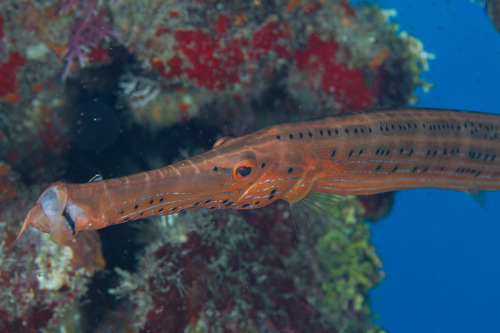
Western Atlantic Trumpetfish
Aulostomus maculatus
A master of disguise and the 'vertical ambush,' the Western Atlantic Trumpetfish is the reef's most slender and stealthy predator. From bright yellow to deep brown, its ability to change color and hide in plain sight makes it a fascinating discovery for every underwater observer.
Quick Identification
Size
Typically 40–80 cm (16–31 inches) in length, though some individuals can reach up to 91 cm (36 inches).
Colors
Highly variable due to camouflage abilities; common phases include bright yellow, reddish-brown, and blue-gray, often with pale streaks or small black spots.
Key Features
- Long, tubular snout with a small mouth at the end
- Highly compressed, slender body shape
- A distinct fleshy barbel on the lower jaw
- Small dorsal and anal fins positioned far back near the tail
When You’ll See Them
Sightings on EverydayEarth
Jul 19, 2026
A vibrant and busy reef scene shows high biodiversity. Dozens of Caribbean Bluehead Wrasse dart between the coral heads, while a Western Atlantic Trumpetfish glides slowly across the top of the frame. An Atlantic Sergeant Major is visible near a large sea fan, and a school of French Grunts occupies the lower reef. In the background, Blue Chromis swim in the open water while a large Stoplight Parrotfish passes through.
Jul 19, 2026
A vibrant underwater scene on a coral reef wall. A Tomtate swims across the lower-left foreground, showing its striped patterns. In the background and upper water column, two yellow-phase Trumpetfish drift slowly, one displaying a vertical orientation typical of the species. A small, bright yellow Bluehead Wrasse flits quickly through the middle of the frame among the swaying sea fans.
Jul 15, 2026
A vibrant reef scene with a variety of tropical fish. A French Grunt hovers near the center, while several small yellow Bluehead Wrasses dart through the sea fans. A long, slender Trumpetfish glides across the background, and finally, a large teal Stoplight Parrotfish swims into view from the left.
Jun 7, 2026
The reef is active with various species. A Trumpetfish is positioned vertically in the lower-left corner, staying nearly motionless to blend in with the surrounding gorgonians. In the open water above the reef, a Bar Jack swims purposefully across the frame, and a group of small Blue Chromis are seen foraging in the current.
Apr 25, 2026
A vibrant coral reef scene teeming with life. Several Blue Chromis swim actively in the open water column, while Atlantic Sergeant Majors and Bluehead Wrasse dart among the large sea fans. A slender Trumpetfish is also visible, utilizing its elongated shape to blend in near the swaying vegetation.
Geographic range
Where Does the Western Atlantic Trumpetfish Live?
The Western Atlantic Trumpetfish is a hallmark species of the tropical and subtropical waters of the Western Atlantic Ocean. Its native range begins as far north as Bermuda and the Florida Keys, extending southward through the entire Caribbean Sea and the Gulf of Mexico. Its distribution continues along the Central and South American coastlines, reaching as far south as the territorial waters of Brazil. They are almost exclusively found in reef-associated environments where their camouflage is most effective.
Basemap © OpenStreetMap contributors
Recorded on EverydayEarth
Behavior
The Western Atlantic Trumpetfish is a master of stealth and specialized hunting techniques. Unlike many reef fish that swim horizontally, the Trumpetfish is frequently seen hovering vertically, head-down, among sea fans and pipe sponges. This posture allows its slender body to blend in with the surrounding vertical structures, making it nearly invisible to both predators and unsuspecting prey. It is a solitary hunter that relies on extreme patience and camouflage rather than speed.
One of its most fascinating social behaviors is 'shadowing.' The Trumpetfish will swim closely alongside a larger, non-predatory fish, such as a parrotfish or a large grouper, using the larger animal as a moving blind. By hiding behind the bulk of the other fish, the Trumpetfish can sneak up on small fish and crustaceans. While generally indifferent to divers and underwater cameras, they will slowly drift away or change color if they feel threatened or closely pursued.
EverydayEarth exclusive
Camera Tips
To capture the Western Atlantic Trumpetfish on an AI-powered underwater camera, your placement strategy should revolve around vertical reef architecture. Position your camera near gorgonians (sea fans), tall sponges, or whip corals. Because these fish spend much of their time hanging vertically to mimic these structures, a camera aimed at a 'forest' of sea fans is your best bet for catching them in their natural hunting posture.
Since these fish are masters of camouflage, use a camera with high-resolution sensors and avoid locations with heavy backlighting from the surface, which can wash out their subtle color patterns. If your setup allows for external lighting, place your strobes or video lights at a 45-degree angle to the side to bring out the texture of their skin and their vibrant color phases, particularly the rare bright yellow morph. Keep your frame relatively wide; their long, thin bodies can be difficult to track if the field of view is too narrow.
The most dramatic footage involves their 'strike' or their 'shadowing' behavior. If you notice a large, slow-moving herbivore like a parrotfish frequently passing a certain spot, aim your camera there. Trumpetfish often follow these larger fish closely. Set your camera to a high frame rate (60fps or higher) if possible, as the vacuum-feeding strike happens in a fraction of a second and is often missed at standard speeds.
Frequently Asked Questions
Record Western Atlantic Trumpetfish at your habitat
Connect a camera to start building your own species record — AI identifies every visitor automatically.