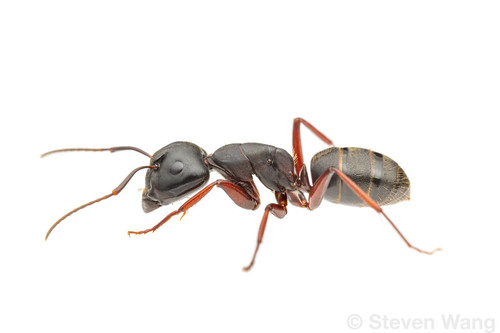
Western Black Carpenter Ant
Camponotus modoc
The Western Black Carpenter Ant is a forest architect recognizable by its impressive size and signature reddish-maroon legs. As a key player in the Pacific Northwest ecosystem, these ants turn old wood into thriving subterranean cities.
Quick Identification
Size
Workers range from 1/4" to 1/2" (7–13 mm); Queens can reach 3/4" (20 mm)
Colors
Matte black body with distinct dark reddish-brown to maroon legs
Key Features
- Large size with a smoothly rounded thorax
- Deep reddish-maroon legs contrasting with a black body
- Heart-shaped head on larger workers
- Single node (petiole) between the thorax and abdomen
When You’ll See Them
Behavior
Western Black Carpenter Ants are highly social insects known for their impressive colony structure. Unlike termites, they do not eat wood; instead, they excavate galleries within moist or decaying wood to create nesting sites. A single colony often consists of a parent nest, where the queen resides, and several satellite nests spread across a backyard or woodland area. You will often see them traveling in distinct 'ant highways' along fallen logs or garden borders.
These ants are most famous for their mutualistic relationship with aphids. They act as tiny ranchers, protecting aphid colonies from predators in exchange for honeydew, a sugary secretion. While they can be a nuisance if they move into the structural timbers of a home, in the wild they are essential decomposers that help break down old stumps and recycle nutrients back into the soil.
Interaction with humans is generally peaceful, though they will defend their nest if disturbed. They have powerful mandibles and can deliver a sharp pinch, often accompanied by a spray of formic acid into the bite, which causes a stinging sensation. However, they are not aggressive and prefer to forage under the cover of darkness.
EverydayEarth exclusive
Camera Tips
To capture high-quality footage of Western Black Carpenter Ants, you need to think small and focus on 'travel corridors.' Look for trails along the edges of garden beds, the bark of large Douglas firs or pines, or the top of wooden fence rails. Because these ants are relatively large for insects, a standard trail camera with a 'macro' lens attachment or a dedicated backyard bug-cam works best. Position the camera just 4 to 6 inches away from a known trail to capture the intricate details of their mandibles and reddish legs.
Since this species is primarily nocturnal, the quality of your camera's infrared (IR) flash is critical. However, be careful with 'white-out'—their black bodies can sometimes absorb too much light, or the IR can reflect harshly off the wooden surface they are walking on. To combat this, try to angle the camera at a 45-degree slope relative to the trail rather than pointing it straight down. This provides a side profile of the ants, making it easier to distinguish the red legs from the black body.
If you want to guarantee a 'starring role' for your camera, set up a bait station. A small bottle cap filled with a 50/50 honey and water solution or a tiny smear of canned tuna will attract workers within minutes. Place the bait on a flat, neutral-colored rock or piece of wood to provide high contrast for your photos. This 'hub' will encourage social behaviors like trophallaxis (food sharing), which makes for fascinating video content.
Keep an eye on the weather for 'nuptial flight' events. On warm, humid evenings in late spring or early summer, winged virgin queens and males emerge from the nest in large numbers. If you time your camera placement near an exit hole during these nights, you can capture the rare sight of the colony’s reproductive members taking flight to start new colonies. Set your camera to 'Burst Mode' to catch the rapid movement of their wings.
Frequently Asked Questions
Record Western Black Carpenter Ant at your habitat
Connect a camera to start building your own species record — AI identifies every visitor automatically.