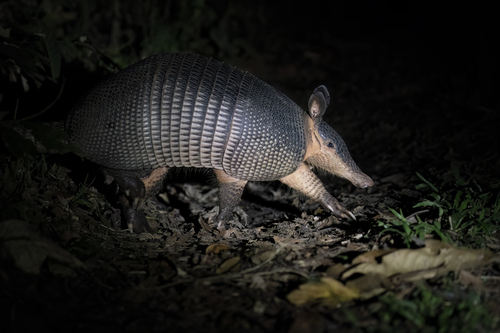
Western Greater Long-nosed Armadillo
Dasypus pastasae
The Western Greater Long-nosed Armadillo is a prehistoric-looking titan of the Amazonian undergrowth. Bulkier and more elusive than its common relatives, this nocturnal specialist is a master of the humid forest floor.
Quick Identification
Size
Head-body length 51–58 cm (20–23 in), tail length 35–48 cm (14–19 in), weight 8.5–10.5 kg (18.7–23.1 lbs)
Colors
Dark brownish-gray carapace, paler yellowish-white scales on the lower flanks, uniform gray tail
Key Features
- 7 to 8 movable bands on the mid-section
- Distinctly elongated, tube-like snout
- Large, upright ears
- Large body size significantly bulkier than the common Nine-banded Armadillo
When You’ll See Them
Geographic range
Where Does the Western Greater Long-nosed Armadillo Live?
Native to the South American continent, the Western Greater Long-nosed Armadillo is a specialist of the western Amazon Basin. Its core range encompasses the humid lowlands of eastern Ecuador, eastern Peru, and southern Colombia, extending into western Brazil and parts of southern Venezuela. Unlike the common Nine-banded Armadillo, this species remains strictly within tropical forest biomes and has not been introduced to other continents.
Basemap © OpenStreetMap contributors
Behavior
The Western Greater Long-nosed Armadillo is a solitary and highly nocturnal mammal that spends its daylight hours tucked away in deep, complex underground burrows. Unlike some of its smaller cousins, this species is more of a forest specialist, rarely venturing into open grasslands or heavily disturbed areas. It moves with a steady, shuffling gait, using its keen sense of smell to detect prey beneath the leaf litter.
Socially, these armadillos are largely independent, only coming together during the breeding season. They are not known to be aggressive, but they are incredibly powerful diggers; when threatened, they prefer to retreat into a burrow or use their strong claws to anchor themselves into the earth. To humans, they are ghosts of the forest, often only identified by the sounds of their rustling in the dry leaves or the unique shape of their tracks in the Amazonian mud.
EverydayEarth exclusive
Camera Tips
To capture the Western Greater Long-nosed Armadillo on camera, you must focus on the forest floor. These animals are low-slung, so your camera should be mounted no higher than 12 inches (30 cm) off the ground. An upward tilt of a few degrees can help capture the distinctive long snout as they forage. Because they are strictly nocturnal, a camera with a high-quality, 'no-glow' infrared flash is essential to avoid spooking them or washing out the reflective scales of their carapace.
Look for 'armadillo highways'—well-worn paths through the leaf litter that lead toward water sources or between large buttress roots. If you find a burrow entrance that looks active (clear of spiderwebs with fresh tracks), aim your camera at a 45-degree angle to the entrance. This increases the 'trigger window,' giving the camera enough time to wake up as the animal emerges or enters. Avoid pointing the camera directly into the hole, as the IR flash may overexpose the image.
Baiting for this species is difficult because they are specialists, but fresh mounds of overturned leaf litter or even a small amount of damp cat food can sometimes pique their curiosity. In the Amazonian environment, humidity is your biggest enemy; ensure your camera has fresh desiccant packs inside the housing to prevent lens fogging during the peak activity hours of the humid night.
Set your camera to take bursts of three photos or short 15-second videos. This species often stops to dig, providing excellent opportunities for clear, still shots. If using video, ensure the audio is enabled; the heavy rustling and sniffing sounds of a Western Greater Long-nosed Armadillo are highly distinctive and add great value to your wildlife observations.
Frequently Asked Questions
Record Western Greater Long-nosed Armadillo at your habitat
Connect a camera to start building your own species record — AI identifies every visitor automatically.