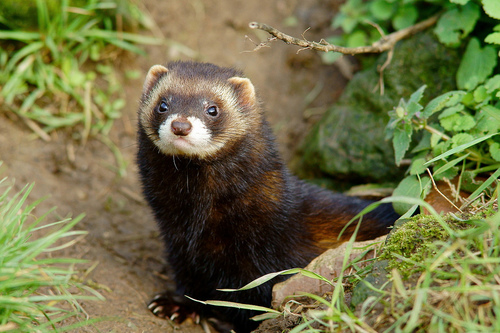
Western Polecat
Mustela putorius
The wild ancestor of the domestic ferret, the Western Polecat is a masked marauder of the night. Once rare, this elusive carnivore is making a stealthy comeback in backyards across Europe.
Quick Identification
Size
Head-body length 35–46 cm (14–18 in); tail 11–17 cm (4–7 in); weight 0.5–1.5 kg (1.1–3.3 lbs). Males are significantly larger than females.
Colors
Dark brown or blackish guard hairs over a pale yellow undercoat; white patches on the muzzle, ear tips, and above the eyes forming a mask.
Key Features
- Distinctive white 'bandit mask' around the eyes and muzzle
- Dark legs and tail contrasting with a paler yellowish torso
- Low-slung, compact body with short, powerful limbs
- Characteristic foul-smelling scent glands used for marking.
When You’ll See Them
Geographic range
Where Does the Western Polecat Live?
The Western Polecat is primarily native to the European continent, stretching from the Atlantic coast of Portugal and the United Kingdom eastward through Central Europe into European Russia. It is also found in the Rif Mountains of North Africa. While it is absent from the far north of Scandinavia and most Mediterranean islands, its population has seen a significant recovery in Western Europe over recent decades, reclaiming much of its historical range in the British Isles and reclaiming territory in urbanized landscapes.
Basemap © OpenStreetMap contributors
Behavior
The Western Polecat is a solitary and primarily nocturnal hunter that moves with a stealthy, low-profile gait. Unlike its more arboreal cousins like the Pine Marten, the polecat is a ground-dweller that prefers to stick to cover, often using the burrows of its prey or natural crevices as dens. It is famously territorial and uses its highly developed anal scent glands to leave pungent messages for other polecats—a trait that earned it the nickname 'foul-mart'.
While they are generally shy and avoid direct human contact, polecats are remarkably adaptable and have increasingly moved into agricultural landscapes and suburban fringes where prey is abundant. They are proficient swimmers and are often found hunting near water. In social terms, they only come together during the breeding season in late winter and early spring, with the rest of the year spent in a solitary patrol of their home range.
EverydayEarth exclusive
Camera Tips
To capture a Western Polecat on camera, placement is everything. These mustelids are 'edge-dwellers,' meaning they prefer to travel along linear features like hedgerows, stone walls, or the base of garden fences rather than crossing open lawns. Set your camera just 15–20 cm (6–8 inches) off the ground and angle it slightly downward. If you have a compost heap or a woodpile, these are prime locations as they attract the rodents that polecats hunt.
Because they are strictly nocturnal and move with quick, erratic bursts, you need a camera with a fast trigger speed (under 0.3 seconds) and a high-quality infrared flash. To keep them in the frame longer, use a scent lure. Smelly baits like tinned sardines in oil or wet cat food work wonders. Secure the bait in a perforated container or under a heavy stone so the polecat has to work for it, giving you plenty of time to capture high-quality video or several burst photos.
During the spring mating season (March to May), polecats are more active and less cautious, making this the best time for sightings. If your camera supports 'Hybrid Mode' (taking a photo followed by a video), enable it. The photo captures the initial movement, while the video allows you to observe their unique 'bounding' gait and check for the tell-tale white mask that distinguishes them from feral ferrets. Always ensure your camera is positioned in a shaded area to avoid false triggers from moving vegetation during the day.
Similar Species
Species that look similar or are commonly confused with Western Polecat.
Frequently Asked Questions
Record Western Polecat at your habitat
Connect a camera to start building your own species record — AI identifies every visitor automatically.