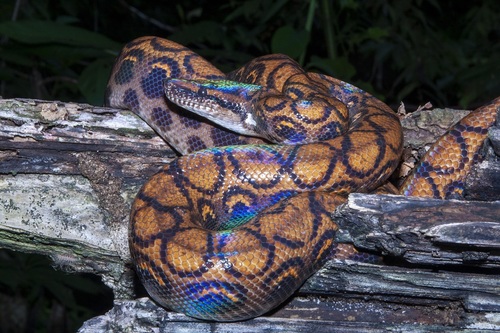
Western Rainbow Boa
Epicrates cenchria
Witness the living jewel of the Amazon, a serpent world-renowned for its shimmering, holographic scales and gentle nature. The Western Rainbow Boa is a nocturnal masterpiece of structural coloration, hiding in the shadows of the humid rainforest.
Quick Identification
Size
1.5 to 2.1 metres (5 to 7 feet) in length; typically weighing 1.3 to 4.5 kg (3 to 10 lbs)
Colors
Rich mahogany or brick-red base with black ring-like ocelli; iridescent scales that shimmer with a holographic rainbow effect in direct light
Key Features
- Holographic iridescent sheen across the scales
- Dark, crescent-shaped or circular markings along the back and sides
- Heat-sensing pits located along the labial scales (lips)
- Slender, muscular body with a prehensile tail
When You’ll See Them
Geographic range
Where Does the Western Rainbow Boa Live?
Native to the lush landscapes of South America, the Western Rainbow Boa’s heartland is the sprawling Amazon Basin. Its core range extends across Brazil, Peru, and Venezuela, but it is also frequently encountered in the humid forests of Suriname, French Guiana, and parts of Bolivia. While they are primarily found in undisturbed rainforests, they can occasionally be spotted near agricultural edges where rodent populations are high.
Basemap © OpenStreetMap contributors
Behavior
The Western Rainbow Boa is a primarily nocturnal and semi-arboreal hunter, spending its time both on the forest floor and coiled within the lower canopy. They are famous for their calm temperament compared to other boas, though juveniles can be quite defensive and 'nippy' until they grow in size and confidence. During the day, they prefer to remain hidden in hollow logs, abandoned burrows, or thick leaf litter where humidity remains high.
As solitary creatures, they only seek out others during the breeding season. They are ambush predators that rely heavily on their specialized heat-sensing pits to track warm-blooded prey in total darkness. While they are not considered a threat to humans, they are highly sensitive to environmental changes and require high humidity to maintain their health and facilitate the shedding of their spectacular iridescent skin.
EverydayEarth exclusive
Camera Tips
To capture the elusive Western Rainbow Boa, camera placement is everything. These snakes are semi-arboreal, so you should aim your camera at 'transition zones'—places where the forest floor meets climbing structures. Position your camera about 1 to 2 feet off the ground, angled slightly upward toward fallen logs or low-hanging thick branches. These are the natural highways the boas use to move between their hunting grounds and hiding spots.
Since these snakes are strictly nocturnal, a camera with high-quality infrared (no-glow) flash is essential. Standard white light flashes can startle the snake, causing it to flee before you get a clear sequence of photos. To truly capture their famous iridescence, try to position the camera in a spot where it might catch the first rays of morning light or use a camera with a high-intensity IR array that can pick up the texture of their scales.
Focus your efforts near water sources or areas with high humidity. Western Rainbow Boas are prone to dehydration and are often found near small streams, ponds, or even large puddles after a rainstorm. If you have a backyard water feature in a tropical climate, placing a camera nearby is your best bet. Keep the trigger speed fast—while they move slowly when prowling, their strike and subsequent constriction of prey happen in the blink of an eye.
Frequently Asked Questions
Record Western Rainbow Boa at your habitat
Connect a camera to start building your own species record — AI identifies every visitor automatically.