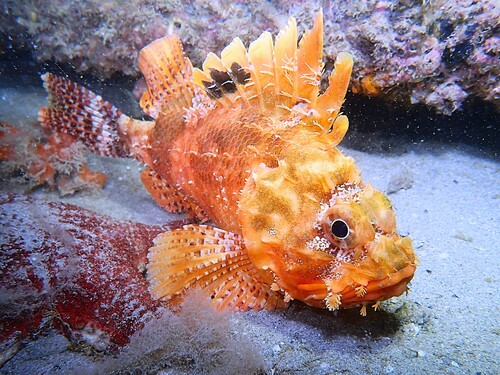
Western Red Scorpionfish
Scorpaena sumptuosa
A master of disguise found in the rugged waters of Western Australia, the Western Red Scorpionfish is the ultimate ambush predator. With its venomous spines and near-perfect camouflage, it is a fascinating challenge for any underwater wildlife enthusiast.
Quick Identification
Size
Up to 40 cm (16 inches) in length; weighs up to 1.5 kg (3.3 lbs)
Colors
Vivid reddish-orange to deep pink with mottled patterns of brown, white, and darker red for camouflage.
Key Features
- Broad, heavy head covered in bony ridges and spines
- Intricate mottled pattern resembling reef sponges and rocks
- Large, fan-like pectoral fins
- 12 venomous dorsal spines for defense
When You’ll See Them
Behavior
The Western Red Scorpionfish is a solitary and sedentary ambush predator that relies almost entirely on its incredible camouflage. It spends the vast majority of its life sitting motionless on the seafloor, tucked into rocky crevices, or perched among sponges. By mimicking the textures and colors of its environment, it remains invisible to both predators and unsuspecting prey, often staying in the same small territory for weeks at a time.
Despite its sluggish appearance, this species is capable of lightning-fast movement. When a small fish or crustacean wanders within range, the scorpionfish opens its massive mouth with explosive force, creating a vacuum that draws the prey in before it can react. While they are generally non-aggressive toward humans, they are highly venomous. Their dorsal spines are linked to venom glands, used strictly as a defensive mechanism against larger predators or clumsy divers.
EverydayEarth exclusive
Camera Tips
To capture the elusive Western Red Scorpionfish, you will need a waterproof trail camera or a remote underwater housing rated for at least 10 meters. For the best results, focus your efforts on man-made structures such as jetty pylons or rocky breakwaters. Use a heavy-duty strap or a weighted tripod base to secure the camera roughly 30 to 60 centimeters (1-2 feet) from the substrate. Look for areas with high sponge growth or craggy limestone, as these are the preferred 'hiding spots' for this species.
Because these fish are masters of disguise, standard motion detection can sometimes struggle to trigger. Setting your camera to 'Time Lapse' mode with a frequent interval (e.g., every 30 seconds) during the peak hours of dawn and dusk is often more effective than relying on a PIR sensor underwater. If your camera allows, use a high-frame-rate video setting (60fps or higher); the strike of a Western Red Scorpionfish happens in a fraction of a second, and standard video may only show the 'before' and 'after' of a feeding event.
To draw the fish into your camera’s field of view, use a bait cage. Fill a small wire mesh container with oily bait such as smashed pilchards or tuna scraps and secure it directly in front of the lens. The scent will encourage the scorpionfish to hop out from its crevice to investigate. Since they are crepuscular, ensure your camera has high-quality low-light performance. If using artificial lights, red LEDs are preferred as they are less likely to spook the fish or cause 'backscatter' (the reflection of light off particles in the water) than bright white lights.
Finally, always check the swell forecast before deploying equipment. In Western Australia, water clarity is best during periods of low swell and offshore winds. Murky water will make it nearly impossible to distinguish the fish's mottled skin from the background reef. Always be cautious when retrieving your camera by hand near rocky ledges to avoid accidental contact with their venomous spines.
Frequently Asked Questions
Record Western Red Scorpionfish at your habitat
Connect a camera to start building your own species record — AI identifies every visitor automatically.