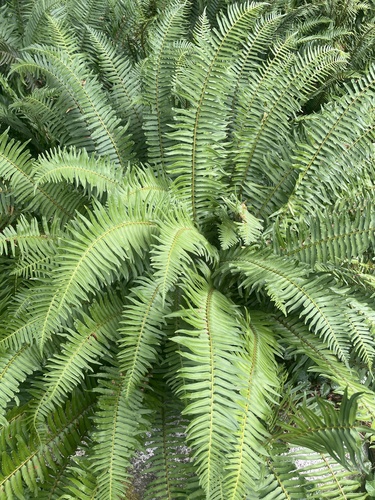
western sword fern
Polystichum munitum
The crown jewel of the Pacific Northwest forest floor, the western sword fern is a rugged, evergreen titan. Its prehistoric fronds provide the perfect emerald backdrop and essential sanctuary for the hidden creatures of your backyard.
Quick Identification
Size
Individual fronds range from 50–180 cm (20–70 inches) long; mature clumps can reach 1.5 meters (5 feet) in diameter.
Colors
Deep leathery green fronds; stipes (stems) are covered in brownish-red or copper scales; sori (spores) are golden to dark brown.
Key Features
- Distinctive 'hilt' or thumb-like projection at the base of each leaflet
- Evergreen, leathery fronds that grow in a circular, crown-like clump
- Rows of circular spore cases (sori) on the underside of mature leaves
- Sturdy, scaly brown stems that emerge as coiled fiddleheads in spring
When You’ll See Them
Behavior
The western sword fern is a resilient, long-lived perennial that serves as a foundational species in western forest ecosystems. It doesn't move like the animals your camera usually tracks, but it displays a rhythmic growth 'behavior' tied to the seasons. In early spring, it sends up tightly coiled, fuzzy fiddleheads from its central crown, which slowly unfurl into majestic fronds. These ferns are incredibly hardy, capable of surviving deep shade, summer droughts, and freezing winter temperatures while remaining green year-round.
Ecologically, this plant acts as a silent host for your backyard's more mobile residents. Its dense, fountain-like structure creates a protected microclimate at its base. Small mammals, amphibians, and ground-nesting birds use the overarching fronds as a natural umbrella, protecting them from both predators and heavy rain. While it doesn't 'interact' with humans in a traditional sense, its presence in a backyard is a sign of a well-established, moisture-retaining habitat that will naturally attract more diverse wildlife.
EverydayEarth exclusive
Camera Tips
Using western sword ferns in your trail camera setup is less about 'catching' the plant and more about using it as the perfect 'stage' for wildlife. Because these ferns provide excellent cover, they are natural crossroads for small mammals and amphibians. Place your camera low to the ground—about 6 to 10 inches high—and point it toward the 'crown' (the base) of a large fern. This is a prime spot to capture footage of shrews, voles, or even Northwestern salamanders that hide in the moist debris underneath the fronds.
To capture the dramatic life cycle of the fern itself, utilize your camera's time-lapse mode during the spring (late March to early May). Secure the camera to a stable post or a nearby tree about 3 feet away from a cluster of emerging fiddleheads. Set the interval to one photo every 2 to 4 hours. Over the course of two weeks, you’ll get a stunning sequence of the 'alien-like' coils unfurling into long, elegant fronds. This is a high-value clip that many backyard observers miss.
Lighting is your biggest challenge with ferns, as they thrive in the deep shade where cameras often struggle with graininess. To get the best results, look for a 'dappled light' area where the sun breaks through the canopy for an hour or two. Position your camera to face away from the sun to avoid glare on the leathery, reflective surface of the leaves. For the most vibrant colors, check your camera after a light rain; the wet fronds take on a deep, saturated green that looks incredible on high-definition sensors.
Finally, consider the seasonal changes in your camera settings. During winter, when other deciduous plants have lost their leaves, the western sword fern will be the only green thing in your frame. This makes it an ideal 'anchor' for your shots. Increase the sensitivity of your AI motion trigger during these months, as the contrast between a moving animal and the static green fern fronds makes for highly reliable detection by most AI camera software.
Similar Species
Species that look similar or are commonly confused with western sword fern.
Frequently Asked Questions
Record western sword fern at your habitat
Connect a camera to start building your own species record — AI identifies every visitor automatically.