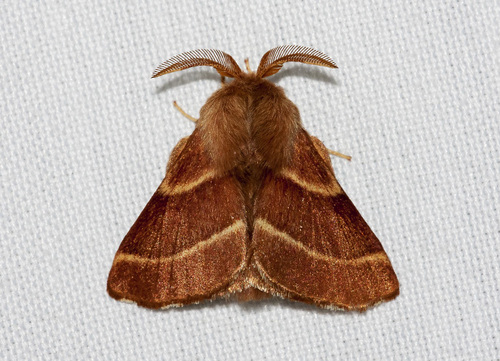
Western Tent Caterpillar Moth
Malacosoma californica
Famed for their communal silk fortresses, Western Tent Caterpillars are one of the most visible signs of spring in the West. From vibrant, social larvae to fuzzy, nocturnal moths, they offer a spectacular look at insect metamorphosis.
Quick Identification
Size
Adult wingspan of 25–50 mm (1–2 in); larvae reach 50 mm (2 in) in length
Colors
Adults are reddish-brown to pale yellow with two darker lines on the forewings; larvae have blue, orange, and black patterns with fine hairs
Key Features
- Elaborate silken 'tents' built in tree branch crotches
- Adult moths have stout, hairy bodies and feathery antennae
- Caterpillars exhibit vibrant blue and orange lateral markings
- Egg masses appear as shiny, dark bands wrapped around twigs
When You’ll See Them
Geographic range
Where Does the Western Tent Caterpillar Moth Live?
The Western Tent Caterpillar is native to the western half of North America, with a range that extends from the southern provinces of Canada through the western United States and into northern Mexico. It is particularly common in the Pacific Northwest, the Great Basin, and the Rocky Mountain region. While it is a native species, its population is known for dramatic cyclical outbreaks where millions of caterpillars may dominate local landscapes before naturally declining.
Basemap © OpenStreetMap contributors
Behavior
Western Tent Caterpillars are highly social insects known for their gregarious lifestyle during the larval stage. Immediately after hatching in the spring, siblings work together to weave a complex, multi-layered silk tent in the fork of a host tree. This structure acts as a communal home, providing protection from predators and a microclimate that keeps the larvae warm during the chilly early spring mornings. They are rhythmic foragers, leaving the tent en masse three times a day—typically at dawn, midday, and dusk—to feed on nearby foliage before returning to rest and digest.
As the caterpillars mature, they become more solitary and eventually leave the tree to find a protected spot to spin a cocoon and pupate. The adult moth stage is remarkably brief, lasting only a few days. During this time, the moths do not eat, as they lack functional mouthparts. Their entire existence is dedicated to reproduction; they are nocturnal fliers that use pheromones to locate mates and deposit egg masses that will overwinter and hatch the following spring.
EverydayEarth exclusive
Camera Tips
To capture the fascinating life of the Western Tent Caterpillar, focus your camera efforts on two distinct phases. In the spring (April to June), look for the characteristic white silk tents in the crotches of fruit trees or willows. Mount your camera on a nearby branch or a tripod using a macro lens or a close-focus setting. Because the caterpillars are active during the day, standard trail cameras with high-resolution video can capture time-lapse footage of them emerging from the tent to feed or adding new layers of silk to their structure.
For the adult moth phase, which occurs in mid-summer, you will need a different strategy. Since these moths are nocturnal and strongly attracted to light, you can set up a 'moth wall' using a white sheet and a UV or mercury vapor light. Position your AI-powered camera to face the sheet. The moths will land and remain still for long periods, allowing for clear, detailed identification photos. Use a fast shutter speed if your camera allows, as their vibrating wings can cause motion blur even when they are perched.
Don't overlook the egg-laying stage. In late summer, keep an eye out for females depositing their egg masses on slender twigs. These look like small, varnished brown bumps. Setting a camera to record at a very close range on these twigs can provide a rare look at the beginning of the life cycle. Ensure your camera is weather-sealed, as the best activity often happens during the transition from cool nights to warm, sunny mornings.
If you are using a motion-activated camera for the larvae, set the sensitivity to high. While a single caterpillar might not trigger the sensor, a mass movement of hundreds of siblings leaving the tent usually will. Experiment with 'Photo + Video' mode to get a high-quality still for identification followed by a video clip that captures their unique 'marching' behavior along silk trails.
Frequently Asked Questions
Record Western Tent Caterpillar Moth at your habitat
Connect a camera to start building your own species record — AI identifies every visitor automatically.